
About the Book:
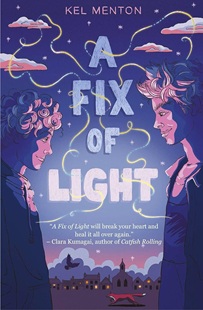
Ten years in the making, A Fix of Light is trans love story with a dark magical twist, from Kel Menton, an astonishing new Irish voice in YA fiction.
18-year-old Hanan’s life is already complicated enough but when he develops a strange new power, his emotions begin to magically manifest in the world around him. Then he meets Pax, a witty 19-year-old trans boy with fox-like features, and an intense romance blossoms. What Pax doesn’t know is that when he touches Hanan, he mutes his new power. Is Hanan’s love real, or is he just using Pax?
In their search for the source of Hanan’s power, the boys discover Aodhán, a mischievous fey who lives in a forest. Aodhán’s truth-telling reveals Pax’s own secret: he is a shapeshifter. The truth threatens to drive the boys apart, but with dangerous forces from his past pursuing him, Pax needs Hanan just as much as Hanan needs him.
Add this book to your Goodreads shelves here. Read Sifa’s review here. Find this book on Bookshop.org (affiliate link).
About the Author:
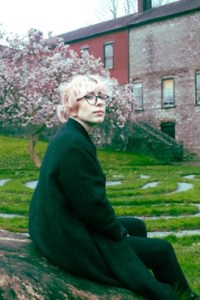
KEL MENTON (they/them) is a non-binary, neurodivergent writer from Cork in Ireland. Kel works in youth theatre as a facilitator and playwright mentor. They were selected as a Young Writer Delegate for the 2021 Dublin Book Festival. They hold a master’s in medieval English literature from University College Cork.
Instagram | Tumblr | Substack | TikTok
Interview:
How did you approach building Skenashogue, particularly Wren’s coffee shop? I really liked how that shop felt so safe and cosy (most of the time).
Skenashogue, and the Wren’s Nest, are sort of Frankenstein’s monsters – I’ve taken bits of real places and stitched them together just so. Or maybe I should say that I’ve taken memories of places and stitched them together.
I wanted to capture the magic that feels embedded in Irish coastal towns and villages, especially the magic I felt when I was a child and wrote messages to mermaids in the sand or looked for dragons in the hills. I hoped that setting would make a good juxtaposition with the darker teenage feelings in the plot!
The Wren’s Nest is made up of fragments of indie cafés that I frequented in my teenage years. I used to get a bus into Cork City and spend full Saturdays just meandering from café to café, sometimes with friends (we’d share pots of tea until it was clear we’d overstayed our welcome), and sometimes to read or write. I didn’t like much about being a teenager, but I liked those moments, and I wanted to give them to Hanan and Pax.
I found it very interesting how the magic’s prominence changed over the book, starting in a place where it felt like it could be real or just a metaphor for the boys’ emotions and slowly transitioning to undeniably there. What was the thinking behind this choice? Was it an easy balance to strike?
It was definitely not easy, and took a lot of editing, haha! I’m really happy with how it turned out, though.
As both a writer and a reader, magic has always been my favourite metaphorical tool. You can exaggerate and put form on things that otherwise are invisible, or difficult to communicate.
I was a teenager with BPD and undiagnosed autism – a huge part of my teenage life was invisible and incommunicable to other people. Direct or literal language (“I feel sad” or “My ears hurt when you do that”) wasn’t sufficiently translating what my experiences were like. But magic could. Metaphor could.
Magic in A FIX OF LIGHT is metaphorical, it’s all to do with emotional regulation and self actualisation and gender and and and. I don’t know how I could accurately convey Hanan and Pax’s experiences and feelings without the magic of metaphor or the metaphor of magic, as it were. So in one sense it’s real, in another it’s figurative. I think that’s where the blend came from.
This magic is drawn from Irish mythology and folklore, which is such a massive and varied body to draw from. Was it hard picking which bits to include? Did anything particularly guide that choice?
It wasn’t hard to pick, strangely enough! When I learned, as a teenager, that Ireland used to have wolves, I was eager to find out as much as I could about them. I took out a book on Irish wolves from my local library and devoured it — that was when I discovered we had our own tales of shapeshifters, people who would turn into wolves.
I love werewolves. I love shapeshifting. The metaphorical potential is heady, especially since I’m fascinated with monsters, the Other, gender, and the body. Drawing on the existing mythology seemed like a natural choice.
The Good Folk, or faeries, have captured my imagination since I was a child, too. The Folk in Irish mythology are much less sexy than the faeries in a lot of modern YA, (unless you like hawthorns in your eyes?) but they lend themselves really well to stories.
In Ireland, the Folk lead death processions, and live under the hills, and have no blood. It was that sense of the Other, and of a world that exists layered beneath this one, which made the decision to include the Folk inevitable.
A FIX OF LIGHT is at its heart a love story. Did either of the boys take longer to come together? At which stage in the dreaming up process did the magic arrive?
Hanan and his powers arrived simultaneously. I didn’t know how or why or where he got them, but I had a clear image of a boy in his living room staring at the TV while news reports came in about strange phenomena that had been happening in the area — phenomena he had caused.
Pax appeared not long after Hanan, but he took longer to fully reveal himself to me. His sunshiney, witty personality was there, but the finer details — what led him to Skenashogue, what it is about him that silences Hanan’s powers — came much later.
The book is mostly told from Hanan and Pax’s perspective, but George (Pax’s best friend) narrates a few scenes. Do you have a favourite character to write from? Was one harder than another?
I really enjoyed writing from George’s perspective, because she’s so distinct from the boys. She’s a little bit older than them, and has more experience under her belt, so she feels much steadier. I needed her, I think, as much as Pax did.
It was always fun to write from Pax’s perspective, even though his point of view was harder to write than Hanan’s.
Did you have a favourite scene to write? A least favourite?
My favourite parts to write are the angsty, volatile scenes. Something about them is so gratifying to create. Maybe I should apologise for that, haha. I don’t want to spoil anything, but…the fight on the beach was fun to write.
My least favourite scenes to write tend to be absolutely necessary bits of exposition. I agonise a lot over whether I should introduce something now, or later, or if I should even include it at all…
My friends tell me I over-explain the obvious and under-explain the vague. I have no counter-argument.
I liked how, at the beginning, the prose really reflected the disconnect between Hanan and the world. Was there any media in particularly that affected the stylistic choices made in this book?
For sure! I like to draw on different media and try to translate the stylistic choices into a written format. Lots of it ends up being cut, because it feels too forced or too far removed from my own voice. I still think it’s an important step in my process, and influences how I edit!
I don’t know how to write this out in an interesting way, so here’s a list of some of the stylistic influences, instead: Reckless by Cornelia Funke; OMORI by Omocat; The Raven Cycle by Maggie Stiefvater; I’ll Give You The Sun by Jandy Nelson; Studio Ghibli films like Ponyo and Princess Mononoke, and; Demian by Hermann Hesse.
Please could you recommend another YA book by a British or Irish author you think readers would love?
Just one??? I am so terrible at picking just one of anything. But for once I will try to follow the rules.
In the spirit of keeping things speculative and tarot-related, I’m going to recommend Other Words For Smoke by Sarah Maria Griffin. It will have you searching for owls in your walls.
 #UKYASpotlight
Leave a comment