About the Book:
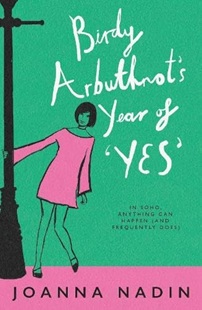
The joyfully funny YA companion novel to The Sunday Times Book of the Week, A Calamity of Mannerings by Carnegie-nominated bestselling author Joanna Nadin. Packed full of scandal, wit and plenty of heart.
‘I suspect that in Soho anything can happen (and frequently does).’
1960 is knocking on the door, and eighteen-year-old Margaret ‘Birdy’ Arbuthnot, presently of Surbiton, wants more than her current existence in the dull suburbs. She wants to LIVE – in capital letters! Could Soho, with its bright lights and dark corridors, hold the key to a life more novel-like and less…Surrey? At the cusp of the new year, Birdy resolves to only say ‘yes’ to everything for the next twelve months. She can’t possibly realise that her biggest ‘yes’ will launch her directly into the London orbit of the aristocratic Mannering family, and transform her life into one worth writing novels about.
Find this book on Goodreads. Find this book on Bookshop.org (affiliate link).
About the Author:

Joanna Nadin is a former broadcast journalist and special adviser to the Prime Minister (not this one). Since leaving politics, she has written more than 90 books for children and adults, including the bestselling The Worst Class in the World series, the Flying Fergus series with Sir Chris Hoy, and the Carnegie-nominated Joe All Alone, which is now a BAFTA-winning and Emmy-nominated BBC Drama. She’s been a World Book Day author, Radio 4 and the i magazine Book of the Year, won the Fantastic Book Award and the Highland Book Prize, and has been nominated for the Carnegie Medal five times. Joanna has been shortlisted for the Roald Dahl Funny Prize, Queen of Teen and the Big Book Awards, among many others. She is a Senior Lecturer in the subject at University of Bristol, as well as teaching for the Arvon Foundation.
Interview:
BIRDY ARBUTHNOT’S YEAR OF YES is a companion novel to A CALAMITY OF MANNERINGS, set three-and-a-half decades later. What made you decide to set this novel in the same world with returning characters (unlike YOUR TEETH IN MY HEART)?
I actually started the novel with only Birdy and her family in Surbiton in my head. But as soon as I started playing around with her narrative arc, it seemed so obvious that in Soho she’d bump into Valentine Mannering, who was about to buy the Pippin Theatre at the end of Calamity. And if she bumped into him, well, why not the rest of the family too? Then it became a question of how to work all my favourites (Marigold especially) back into a very different setting.
How did you decide which returning characters to include and how important they’d be to the plot? Was there anything you wished you could include but the time difference between books meant you couldn’t?
It was really decided for me, in the sense of who would be alive and within the vicinity of Soho and Ickthorpe. So, sadly, I had to lose Grandma, and even Panth and Freddy only have cameos really. It necessarily had to become much more the story of that generation’s children, and of Aster, who had moved to London and become part of the Soho art and fashion scene.
This tale is told through diary entries, raw and unfiltered thoughts (and honest when she’s holding something back). Such a style requires a very strong character voice – and it absolutely comes through. How did you approach building her voice and did the tone change at all during edits?
Birdy actually began life in another book. She was the mother of the protagonist in an adult novel I wrote about five years ago and as such only had a bit part, and a very different trajectory – in that novel she gave up her dreams to marry an MP. This was my chance to give her a real story of her own, and a much happier ending. Once I knew she wanted to become a writer, and I’d moved her from literary fiction to comic YA, her voice gained clarity and wit.
BIRDY ARBUTHNOT’S YEAR OF YES touches on many topics that are as relevant today as they were then – the role of women, queer rights, even nuclear disarmament. How did you choose when and how to give them prominence and when to weave them into the background tapestry?
It can be hard to tackle historical subjects in their own time, because of what would have been accepted then, and because of the restrictions on women and minoritised communities. By making two of the characters would-be journalists, and operating in Soho, which has long been at the heart of diversity in London, I have myself permission to bring in much more than I otherwise might have been able to. So actual historical events provide a background that the characters might comment on, but queer rights and women’s rights are at the very heart of the narrative.
By the end of the book, Birdy has grown in self-knowledge but also has more ways to grow, which reflects the fact that life is a journey of change. What tips would you give someone writing about teen characters wishing to give their characters a satisfying arc of change but wishes to reflect the reality of not getting it all sorted?
I think there used to be such an onus on answering the ‘Who am I?’ question that drives so many coming-of-age narratives. The fact is, we can’t just pick one self, or find our ‘true self’, as that doesn’t exist. Adolescence actually continues well into our twenties, and on top of that, we have many selves and they change throughout our lives. I try to remember that ‘for now’ is an important element of any happy ending.
In order to paint the world of 1960s Soho, what research did you have to do? What resources do to recommend to others interested in this period?
I looked at a lot of photo and newspaper archives, and spent a lot of time walking the area so the map became imprinted on my mind. I then drew my own map, using a 1950s pullout from a book, Tippexing out some clubs, replacing them with my own versions. I also read a huge number of books – both fiction and non-fiction. I recommend Absolute Beginners by Colin MacInnes, Soho in the Fifties by Daniel Farson, and Tales from the Colony Room by Daniel Coffield.
As someone who was diagnosed “late” with autism, how has that affected how you approach characters now and making the decision whether or not to explicitly label a character? For Sifa (also late diagnosed), Marigold and Julian very much spoke to her and the different ways the world perceives autistics depending on how they present and who they are. Are there other characters you think would, if they were around today with our better understanding of neurodivergence, be diagnosed?
That is fascinating. When I wrote this book, I was undiagnosed, but Marigold and Julian were very much based on me and my brother and so it pleases me greatly that they resonate. I would never ‘diagnose’ them on the page, even with the third Mannerings novel, which is focused on a seventeen-year-old Marigold, as that just would never have happened (it still barely happens now with women). But by explicitly ‘coding’ them for other autistic readers, I feel I can make it clear that we have always existed. Now, I spot autistic characters everywhere in both my and others’ writing (Mr Darcy, for example).
Thank you, Joanna!
 #UKYASpotlight
Leave a comment