The Annual Event is a month long celebration of all things UKYA, highlighting books by British and Irish authors (resident and national) and asking their views on topic affecting the community. All views are the author’s own.
About the Authors:
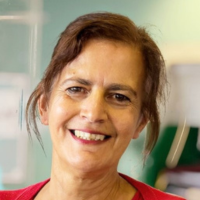
Amanda Addison is an award-winning author of books for adults and children. Her writing has been translated into German, Greek, Italian and Ukrainian. A graduate of Chelsea School of Art, her writing and artwork are inspired by travel, textiles, and the natural world. Amanda holds an MA in Writing the Visual and lectures in Art & Design and has also led workshops in Creative Writing at the National Centre for Writing. Amanda believes in the power of stories as a window on the world, and a mirror to better see ourselves and is passionate about stories which are empowering and inclusive.

Jess Popplewell is the author of THE DARK WITHIN US, winner of the 2022 Times Chicken House Chairman’s Prize and the 2025 James Bain Book Award. She is currently writing more spooky YA.
About their books:
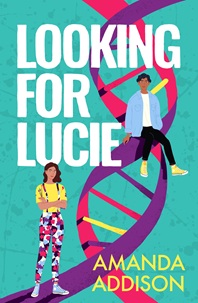
Title: LOOKING FOR LUCIE
Author: Amanda Addison
Pitch: It’s a question every brown girl in a white-washed town is familiar with, and one that Lucie has never been able to answer. All she knows is that her mother is white, she’s never met her father, and she looks nothing like the rest of her family. Well, it matters to Lucie and—with her new friend Nav, who knows exactly who he is—she’s determined to find some answers.
Find on Goodreads. Find on Bookshop.org (affiliate link)

Title: THE DARK WITHIN US
Author: Jess Popplewell
Pitch: When homeless teen Jenny meets demon Luc at a house party, he makes her an offer she never expected – travel in Hell to get her soul back. She thinks she has nothing to lose and everything to gain – but can she really trust a demon?
Find on Goodreads. Find on Bookshop.org (affiliate link).
In your opinion, how has social media helped foster the UKYA community?
Amanda Addison: It gives a shout out to diverse voices and indepentent publishers such as Neem Tree press whose books aim to change and broaden perspectives.
Jess Popplewell: Social media is important in loads of ways for writing communities. A big one for me during my debut year was a Twitter/X group of lots of other UK children’s authors all supporting each other through what can be a bit of a stressful time! We offered support and encouragement to each other online, as well as showing up for each others’ book launches and helping boost marketing efforts for everyone in the group. Some of those people are now among my closest writing friends, and I’m especially happy it helped me connect with other authors from the north of England, since so much in-person stuff happens in London usually.
In which ways do you think we can responsibly use social media to introduce YA titles to teenagers? How can we go beyond social media to reach them, given conversations in several countries around re-thinking current legislation on such platforms for minors?
Amanda Addison: Social Media can introduce readers to writers in a personal way. For example I recently took part in Booklings chat podcast with the author/school librarian, Lucas Maxwell, where I not only talk about Looking for Lucie, but also about the whole creative process and how I personally seek to balance my own reading and writing with social media.
I would love to see other librarians reach out on social media and introduce young people to books and in-person events.
Jess Popplewell: Personally, I think initiatives like UKYA are the perfect schemes for social media when it comes to introducing and promoting YA books to teenagers. I don’t think authors talking directly to readers is always the best route – it can be lovely to communicate with readers, of course, but there’s a danger of it all getting a bit parasocial and that’s not what we’re trying to foster usually, it’s the love of books and story rather than a cult of personality. Watching people discuss books they’ve loved and talking to like-minded readers has got to be a priority. In terms of going beyond social media, one of my favourite trends in recent years has been seeing young people spending more time in bookshops, making the choosing of what to buy with friends part of the fun experience.
I’d love to see more of that encouraged in libraries too, and schools can also be part of it – I had a great experience with a recent school book award, which I thought was particularly cool because young people were introduced to books, discussed them and then voted on their favourite, making it very much a community event.
How do you think the YA market is going to change thanks to emerging technologies like AI?
Amanda Addison: Firstly, I was horrified to see that AI has already plundered Looking for Lucie and another of my novels in German translation. We need to protect creatives across all platforms so that they can make a viable living form the creative arts and call out theft when we see it and support legislation which pays and attributes authors.
Any new technology has its pros and cons, and this is the case with AI. AI can only work with what it is given, and unable to make creative leaps of the imagination.
Jess Popplewell: This is a complicated discussion, and I think a big part of that is people not understanding that there are different kinds of AI and what it actually does. If we’re talking about Generative AI like ChatGPT and Claude, then… look, I suspect we will see a huge swathe of poorly-generated books in the next few years. I think most of them will come in via the self-published route, which is a big danger to the thousands of indie-published authors who have poured their souls into their writing already. But some people think of any kind of art as a grift. People who don’t understand writing will try to use AI to create ‘products’ in the hope of making easy money.
I also think that in the main, just like NFT art that was meant to be huge a few short years ago, it will eventually stop happening. Those people will realise there is way more to writing than just pulling a plot out of a machine, and readers will be savvy enough to seek out higher quality voices.
I do think in the meantime, we’re going to lose a lot of hugely talented authors who ultimately decide they can’t wait it out and need to go do other things to make money, and that’s awful, but I do not believe AI is going to kill the concept of being a writer. Honestly, YA readers are already suspicious of poor quality writing and stories that feel like they’ve been written entirely to a formula, and that’s essentially what someone without real love for storytelling will produce, even with the help of AI.
What steps would you like publishing needs to take in response to the rise of AI?
Amanda Addison: I would like the publishing industry to unite and make it illegal for AI to take novels without the author’s permission/payment. We wouldn’t accept a new piece of technology going into a store and plundering it without any consequences!
Jess Popplewell: Two things – for writers, we need to see better protections in place for authors (and, frankly, all artists). If, as recent headlines suggest, tech companies cannot survive without stealing copyrighted works consequence free, they need to rethink their business models – that’s on them, and it shouldn’t negatively impact authors and artists.
For readers though, we also need to be thinking carefully about what intrinsic value there is in enjoying, discussing and analysing written text. We’re not just ‘pumping out content’, we’re building communities of people who love stories, characters, and worlds – and we need to encourage that as much as possible so the next generation of readers and writers feel they’ve got the skills to keep it going.
Thank you all! For more interviews, check here and don’t forget to check instagram (here) for book recommendations from these authors and more!
 #UKYASpotlight
Leave a comment