The Annual Event is a month long celebration of all things UKYA, highlighting books by British and Irish authors (resident and national) and asking their views on topic affecting the community. All views are the author’s own.
About the Authors:
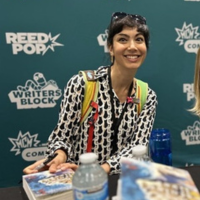
Born in Kalgoorlie in 1982, Sharada Keats loves poetry, nature, reading, writing, electricity, hot running water, petrichor, a certain degree of cliché, and circumstances that ensure young people can enjoy basic human rights, be nurtured, and grow old happily and healthily. She feels strongly that people of all ages deserve a wider variety of stories and storytellers.
Sharada grew up in Australia and Canada, with parents from Guyana and Yorkshire – influences that still shape her writing. She studied agricultural economics in university, and has spent many years working in the third sector. Sharada now lives with her partner, two young children, and ancient old cat in London, UK.
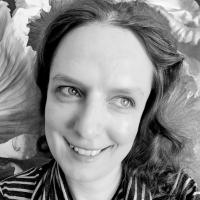
Anna February wrote her first book at the age of six and has been writing ever since. By day, she works as an editor of teaching materials for STEM courses at The Open University, primarily in the field of engineering. By night, she writes speculative fiction for young adults. She and her husband both grew up in Gloucestershire, and have recently moved back to the area with their two children.
Although Anna spends the vast majority of her time trying to arrange the right words in the right order, her other interests include drawing, board games and large amounts of chocolate. She also writes books for older readers under the name A.F.E. Smith.
About their books:
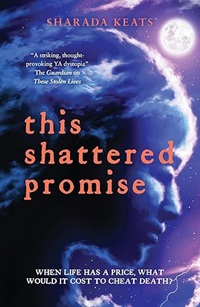
Title: THIS SHATTERED PROMISE
Author: Sharada Keats
Pitch: After the heist at the Life Registry, Mora has been separated from Kit. Targeted for her rare memory and drawing skills, she is stuck helping the Sciencemaster General, Sacrifice Sting, to deliver a breakthrough for the High Governor: the key to immortality. Can the Skøl conquer death itself? And at what price? The secret may lie in ancient Xan knowledge that has long been guarded. In the wrong hands, these powers would be utterly devastating. Can Kit and Mora manage to find each other again – and save their future?
Find on Goodreads. Find on Bookshop.org (affiliate link).
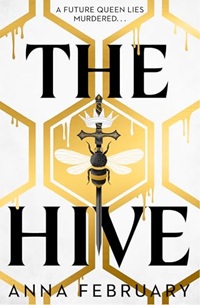
Title: THE HIVE
Author: Anna February
Pitch: Justice is merciless in the Hive, a monarchy of tomorrow, where young bodyguard Feldspar awaits execution, guilty of being alive when her charge is dead. The girl has one defender – Niko, a royal maverick. Together they have three days to prove the impossible. Three days to question everything Feldspar knows about the world that raised her and discover who the real murderer is . . .
Find on Goodreads. Find on Bookshop.org (affiliate link).
In your opinion, how has social media helped foster the UKYA community?
Sharada Keats: Social media is a great way to communicate with people, especially in a world where trad media is tightly controlled, often biased, and not very inclusive.
Anna February: I think what’s great about social media is that it allows YA readers to recommend books directly to each other, without the mediation of gatekeepers. When I was growing up, I found books in the bookstore or my local library, or maybe they were recommended by my school librarian. All of those places were fantastic, of course, but they didn’t offer the same peer-to-peer connections that social media does now.
Books can find runaway success through word of mouth on TikTok or Instagram: chosen by YA readers, for YA readers. And those readers can also bond over their favourite books, talk about theories, share fan art, highlight favourite quotes and so on. So social media has made it much easier to be a book fan and to find likeminded people.
In which ways do you think we can responsibly use social media to introduce YA titles to teenagers? How can we go beyond social media to reach them, given conversations in several countries around re-thinking current legislation on such platforms for minors?
Sharada Keats: I think a lot of value in social media is not necessarily reaching minors themselves directly, but those in their community e.g. librarians, school teachers, etc who can guide them and make suggestions.
Anna February: It’s difficult, isn’t it? Because social media has so many benefits, as I mentioned above, yet there are a lot of downsides as well. It can have serious mental health impacts for everyone, and teens are some of the most vulnerable to that. So I understand why we might want to keep them off social media. But I do worry there’s a danger that reading will decline further as a result.
We already know that a lot of young people don’t read for pleasure. Being part of a community of book lovers is one of the things that might keep them interested in reading instead of the faster-paced and more visual world of video games – because from my experience as a parent, it’s the lure of the tablet and the instant gratification it offers that’s the greatest threat to time spent with a book. So in a world where they didn’t have access to social media, we’d need to find other ways to keep teens interested in books and provide them with the community spaces they could previously find online. There’s a role for bookshops and libraries in that. Conventions, too. Real-world spaces that offer the chance to bond over a shared love of reading.
How do you think the YA market is going to change thanks to emerging technologies like AI?
Sharada Keats: I hope not massively, in that I hope writers, illustrators, designers, marketers etc (across book creation in general, not just YA) reject AI for creative purposes.
Anna February: I think there’s a lot of fear around AI replacing creatives, and in some ways that fear is highly justified. Someone who cares nothing at all for quality could churn out vast numbers of AI-written books at a fraction of the cost of paying real authors, editors and artists (as long as they didn’t mind the cost to the environment and their own humanity). But that view of the future assumes that readers wouldn’t be able to tell the difference, or care if they did. I think we can have a little more faith in readers than that.
In fact, to me, it feels like the YA market has actually moved further towards craftsmanship and away from mass production in recent years. You can see that in the rise of book subscription boxes – all these gorgeous special-edition covers, illustrated endpapers, sprayed edges. Maybe that’s partly in response to the rise of AI; I don’t know. But YA readers are tech-savvy and hyper-critical (and I mean that in a good way). They want their books to be works of art, and they can tell good writing from bad. The books they fall in love with are beautifully designed by real artists and written with time and care by real authors. Not written by bots with AI-generated covers.
What steps would you like publishing needs to take in response to the rise of AI?
Sharada Keats: Given the likes of Meta can scrape mountains of books to train their AI with (so far) very minimal cost or consequence, we definitely need publishing to advocate and push for better governance of AI and copyright regulations that truly protect creatives.
Anna February: As you might be able to tell from my previous answer, I am hugely morally opposed to AI for multiple reasons, including its environmental impacts and its barefaced wholesale theft of intellectual property. Though it has some potentially world-changing applications, I think we’re using it for all the wrong things. (Typical humans! We have a tool that with a bit of work could cure cancer or solve the environmental crisis, and we’re using it to create multiple almost identical images of a six-fingered Donald Trump riding a unicorn.)
The publishing industry is already pushing back against the UK government’s willingness to roll over and let the AI industry take whatever it wants for its own gain. I consider myself lucky that my publisher, Chicken House, include a clause in their contracts that my books won’t be made available for training AI without my consent, and that no AI will be used in cover design or translation. I’d like to see all publishers do the same. Editors, authors and illustrators depend on each other. We need to uphold the value of each other’s work as a uniquely human endeavour. None of us can be replaced by a machine without losing a huge amount of skill, insight and creativity.
Thank you all! For more interviews, check here and don’t forget to check instagram (here) for book recommendations from these authors and more!
 #UKYASpotlight
Leave a comment