The Annual Event is a month long celebration of all things UKYA, highlighting books by British and Irish authors (resident and national) and asking their views on topic affecting the community. All views are the author’s own.
About the Authors:
Scarlett Dunmore studied English and Creative Writing, eventually finding a love for YA literature. When she’s not writing, she can often be found watching scary films or exploring abandoned abbeys, old cemeteries and ruined castles in Scotland for inspiration.
How to Survive a Horror Movie, the first in a new comedy-horror YA series, was published by Little Tiger in 2024. The sequel will be released on the 4th of September, this year.

A.J. Clack moved from a small village in Wales to London, to pursue a career in television. She worked on a wide range of shows from Teletubbies to Friends, while also writing plays for the Edinburgh Fringe and development scripts/pilots for children’s television. She now lives in Essex with a houseful of teenagers and can often be found freezing on the side of a football or rugby pitch.
Lie or Die: Blood Moon is her second novel and is the sequel to Lie or Die.
About their books:
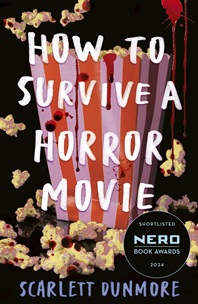
Title: HOW TO SURVIVE A HORROR MOVIE
Author: Scarlet Dunmore
Pitch: A fast-paced tongue-in-cheek horror YA about two friends trying to survive senior year – literally!
Horror movie enthusiast Charley is determined to keep a low profile when she’s enrolled to a girls’ boarding school on a remote island. That is, until someone starts killing off her senior class, putting Charley and her best friend Olive at the centre of their own horror movie. And that’s not the only alarming thing – she’s now seeing the ghosts of her former classmates!?
Find on Goodreads. Find on Bookshop.org (affiliate link).

Title: BLOOD MOON
Author: A. J. Clack
Pitch: Former Lie or Die survivor Kass Kennedy is blackmailed into competing in the reality TV sequel, Blood Moon. Lured to a mysterious location, Kass discovers that these contestants will go to extreme lengths for fame, fortune, and revenge and that far from being on the run, the Lie or Die killer has prepared a deadly comeback. Kass has just three nights of the Blood Moon to identify the Werewolves and save her friends. Lie or Die was just a rehearsal. Reality TV just got darker.
Find on Goodreads. Find on Bookshop.org (affiliate link).
In your opinion, how has social media helped foster the UKYA community?
Scarlett Dunmore: Social media allows readers to connect, forming a wonderful book community where we can share recommendations and reading journeys with each other. It also allows readers to connect with authors, and vice versa. I love engaging with readers on my Instagram page.
A. J. Clack: I think social media has made YA so much more accessible to readers and has introduced a new, older group of readers to a genre which ordinarily they may have not thought of reading.
The BookTok community is especially brilliant at this. Places such as Goodreads, Storygraph, Fable etc allow readers of all ages to communicate and connect with each other and express their opinions, encouraging and nurturing a love of reading and storytelling. It’s empowering, giving the reader a voice in a way that’s never happened before and it really can connect readers and introduce them to a wider pool of books and genres.
From a writer perspective, I find the online community incredibly supportive. It has most definitely helped me with the isolation that comes with the job and enabled me to share experiences and benefit from a collective understanding of the industry. It’s also a great way to support fellow authors and share in their successes.
In which ways do you think we can responsibly use social media to introduce YA titles to teenagers? How can we go beyond social media to reach them, given conversations in several countries around re-thinking current legislation on such platforms for minors?
Scarlett Dunmore: As with all online platforms, there needs to be some degree of monitoring to ensure teens can safely access content. Perhaps with some improved safeguarding on social media platforms, teens can continue to connect with each other and with YA authors in a safe and positive way. Beyond social media, let’s highlight the importance of bookshops and local community activities like book clubs and author events.
A. J. Clack: Ahh this is a tricky one! Safety of younger readers is always paramount, and I wouldn’t encourage anyone to directly reach out on SM platforms to anyone. That said there are some great podcasts and content creators now reviewing and championing YA such as UKYA Spotlight and YA Book Jam that are helping to spread the word and introduce new YA titles to readers. This is a fantastic way of reaching teenagers in this space – great job guys!!
I think the way forward is to try to connect through schools and the community. Authors visiting schools, meeting readers and discussing stories and creative writing is a great way to connect, especially through workshops and smaller group sessions. Also creative writing clubs are fantastic. I recently did a workshop in S Wales with a Saturday morning creative writing group which was brilliant. They meet up once a month to discuss the books they are reading and/or writing and learn creative writing skills. Bookshops are changing and adapting too, some offering café spaces to relax and meet up with friends and I think more could be done in this space to encourage and introduce teenagers to a wider and more diverse range of YA titles.
How do you think the YA market is going to change thanks to emerging technologies like AI?
Scarlett Dunmore: I think the role of AI in storytelling is still to be determined.
A. J. Clack: Well I’m really hoping it won’t! Ok so maybe that’s a tad naïve but I believe that the use of AI within this industry and within the arts in general should be censored and the people that work in this space protected. AI only works well if in an environment where it is not replacing the human but enhancing, there are many medical procedures and research in which AI is genuinely an asset. It does not work if the human experience is being substituted by an algorithm for cost or time factors. If we don’t lay down the rules now, we are putting the whole creative industry in jeopardy.
What steps would you like publishing needs to take in response to the rise of AI?
Scarlett Dunmore: In light of the recent pirated-books controversy, authors need their work protected, so their words aren’t being stolen without permission and used to train AI. All writers should have ownership of their work and be asked permission to use it.
A. J. Clack: It would be nice to see publishing protecting its creatives and drawing a line under all uses of AI in creative media, writing and illustrating. I think in this situation there should be no grey, the answer should be very clear. We do not tolerate the use of AI in either the use of titles being used without consent to train AI, or the use of AI as a creative outlet to replace creative individuals. The minute you start to muddy the water with ifs and maybe’s things get complicated. The answer should be simple- we do not condone the use of AI in any aspect of the creative process, and we fully support and protect all our creatives without exception.
Thank you all! For more interviews, check here and don’t forget to check instagram (here) for book recommendations from these authors and more!
 #UKYASpotlight
Leave a comment