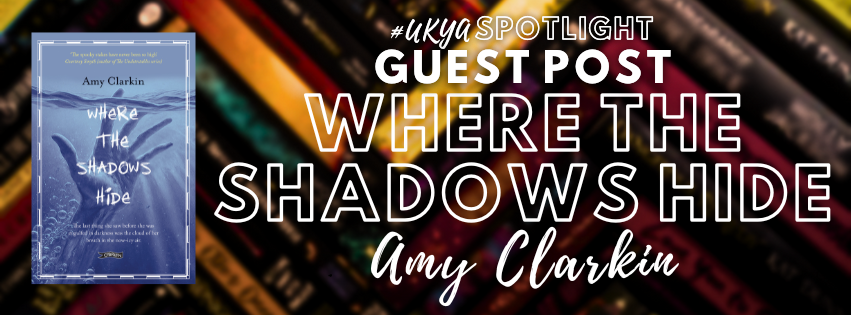
About the Book:

The chill intensified, and Archer opened his eyes to see the candles extinguish one by one …
PSI – Paranormal Surveyance Ireland – are in deep water. When the operators of a luxury cruise ship ask for their help with a series of unexplainable events, Raven and the team are hopeful that this case, for once, won’t endanger their lives.
As they try to blend in with the wealthy passengers, it quickly becomes clear to Davis, Fionn and the others that there is more lurking in the shadows than they’ve realised. With the eerie encounters escalating and rising tensions threatening to tear the team apart, time is running out for PSI. Can they save the ship – and themselves – before it’s too late?
Find this book on Goodreads here. Find on Bookshop.org UK here (affiliate link). Find more information about the book here (publisher’s website).
About the Author:

Amy is a writer from Dublin, Ireland. Her non-fiction writing is often on the theme of chronic illness and identity, and has been featured in Sonder Literary Magazine, Rogue, and Dear Damsels. What Walks These Halls was her debut novel. It was shortlisted for the An Post Irish Book Awards Teen & Young Adult Book of the Year 2023 and nominated for the Yoto Carnegies 2023. Her second novel, Who Watches This Place, was published in 2024.
She can generally be found by the sea, drinking coffee, talking about her dog or asking people what their favourite ghost story is.
The Power of Horror
I am very easily frightened.
This is probably not a statement many people expect from someone who writes horror, who talks constantly about how much she loves the genre. Who gravitates towards spooky stories, especially those about the paranormal. And yet, if you were to watch a horror film with me you’d see me cover my eyes during tense moments. If you spent time with me you’d see how easily I jump when startled, how I run up the stairs after I turn the lights off when I’m alone in the house. I have anxiety, an overactive imagination, and a draw towards anything macabre – which is the perfect recipe for being incredibly easy to scare. I’d also argue it’s a great combination for writing horror.
If you describe any situation I can find a way to make it uncanny. There’s a scene in my debut novel, What Walks These Halls, that readers consistently tell me gave them nightmares.
‘Me too,’ I tell them with a conspiratorial smile.
The gift of being easily scared, of having a mind that likes to jump into the worst case scenario, that searches for the shadows and draws on them, means that writing horror comes naturally to me. Horror is a genre that is often dismissed and overlooked, to the loss of the person overlooking it; it’s a genre with layers and endless depth.
I feel strongly that horror not just allows us to examine what scares us on the surface –a ghostly figure at the end of the bed, a masked figure stalking us through the hallways– but also explore the societal issues that are of concern. I studied English and Film at University, and my favourite modules were classes that focused on the Gothic and Horror. I loved pulling at the threads to see the themes underneath, looking at the popular topics and seeing how they held a mirror up to society. Horror allows us to examine the things that frighten us while also confronting them in a safe way. After all, we can choose to close the book, turn off the tv, pause the podcast. Horror presents us with the worst ‘what if’ and allows us to examine it in a way that we can control.
For me, ghosts have always been a powerful way to explore the things that we fear. I have always been drawn to stories that make us question the characters and what is real and what is not – it’s a way to explore my own feelings around anxiety, about having a brain that always tries to convince me the worst case scenario is the one that will happen. I also have an invisible illness, that can’t be seen on the surface but affects every aspect of my life. It is a condition that is often dismissed medically, that up until recently patients with it were told it was ‘all in their heads’. The stories of protagonists who know that they are haunted and desperately try to seek help, only to be doubted, feel all too familiar to me.
I think that is horror’s power, and what makes it such a nuanced genre to write in. It can have as many layers as you want: Ghosts, vampires, werewolves, serial killers–whatever your ‘monster’ is, they can either simply be the provider of the scares, or they can be a vehicle to embody the anxieties or themes we want to examine ourselves. In What Walks These Halls Raven is haunted, not just by The Lady of Hyacinth House, but her own past, her fears and her trauma. The two are one and the same, and when Raven confronts The Lady she also confronts her own past. All of the ghosts in my books reflect different societal issues, such as class inequality and misogyny, but through the lens of a spooky mystery. Readers can choose to engage with those themes, or simply enjoy the scares along the way. We can see a lot of the concerns of a society or demographic in the horror that is being made, if we delve deeply into the frightening stories being told and think about why they scare us, what anxieties they bring to the surface. They allow us to look those anxieties in the eye, knowing that we’re safe. That once we close the book we can move on with our day, confident that we have overcome the fears inside it.
Horror is a genre that allows you to take as much from it as you want to – it can be solely an adrenaline rush, or it can open the door to delve more deeply into what the ‘monster’ in the story represents. When you write it, it can be a fun and chilling story to write, and it can also become a way to explore themes important to you.
 #UKYASpotlight
Leave a comment