
About the Book:
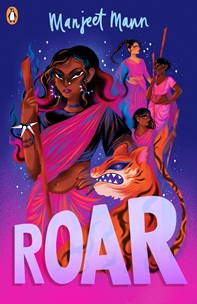
Rizu lives a comfortable life in the gated middle class suburbs of Delhi; her biggest worries are getting her homework done and keeping up with the mean girls at school. That is, until she’s accused of being a witch and the hysteria that follows triggers a chain reaction that ends in tragedy and life as she knew it changes forever.
Alone and fearing for her life, Rizu runs away and joins a group of pink sari wearing, stick wielding women, known for their revenge vigilantism. Together they can help Rizu take back her life and seek justice against those who wronged her.
Because sometimes you have to run through the streets and ROAR.
Find this book on Goodreads. Find on Bookshop.org UK (affiliate link.)
About the Author:
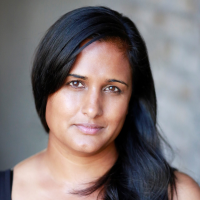
Manjeet Mann is a multi-award-winning author, playwright, screenwriter, and actress. Her debut YA novel, Run Rebel, was shortlisted for the 2021 Carnegie Medal and won the CILIP Carnegie Shadowers’ Choice Award, the UKLA Award, the Diverse Book Award, and the Sheffield Children’s Book Award, as well as being named a Guardian Best Book of 2020. Her second novel, The Crossing, won the 2022 Costa Children’s Book Award, the UKLA Award, and was Overall Winner at the Sheffield Children’s Book Awards. It was also shortlisted for numerous other prizes, including the 2022 Carnegie Medal, Waterstones Children’s Book Prize and YA Book Award. Manjeet writes picture books too, including Small’s Big Dream, which won the Readers’ Choice Award at the Diverse Book Awards. She adapted Run Rebel for the stage with Pilot Theatre, earning Best Production at the 2025 Off West End Stage Awards. Manjeet lives in Scotland.
Interview:
This story explores how misogyny affects women of all social classes in India. What initially drew you to choosing this as the topic of your third book?
What first drew me to ROAR was hearing about the Gulabi Gang in India. These extraordinary women in their bright pink saris standing up to injustice and corruption in their communities. Around the same time, I came across an article about the rise of witch-hunting in certain Indian states. Both really struck me because they weren’t just “distant” stories, they revealed how misogyny and violence cut across every layer of society. It’s about witch hunts in all their forms, about the different ways violence is used to silence women, and most importantly, about what happens when women reclaim their voices. During my research, I was both fascinated and horrified by the real stories I uncovered, and I knew I wanted to explore them in a way that felt truthful but also empowering. For me, this book is about shining a light on injustice, yes, but equally about celebrating resistance, resilience, and the unstoppable power of women speaking up, wherever they are in the world.
Whilst this is primarily Rizu’s story, she is not the only victim of circumstances beyond her control. You mention in your author’s note the reasons why you picked Rizu – an upper caste girl – as the narrator, rather than a Dalit lead. How did you go about crafting the balance of exploring the realities of misogyny and oppression within the castes while keeping the story Rizu’s?
That was something I thought about a lot while writing ROAR. I chose Rizu, an upper-caste girl, as the narrator because I didn’t feel it was my place to write directly from the perspective of a Dalit lead- that experience isn’t mine to tell. But I also knew I couldn’t write a story about misogyny in India without acknowledging how caste intersects with gender and oppression.
So the balance came from making sure those realities were present in the world of the book, without appropriating someone else’s lived experience. Rizu’s privilege gives her certain protections, but it doesn’t shield her from the violence and silencing that women everywhere face, and that contrast felt important to explore. For me, it was about holding up the bigger picture: showing how misogyny affects women across caste and class, but also staying true to Rizu’s voice and her journey.
What steps do you think are necessary for change to take root around these issues, both in India and in the wider world?
I think the first step is recognising that India and the wider world aren’t separate when it comes to these issues. Misogyny, violence, and the silencing of women take different forms in different places, but at their core, they’re part of the same global problem. It’s too easy to look at a story set in India and think, “That happens over there,” when in reality, it’s happening everywhere, just expressed through different systems and structures.
Real change comes from education, from listening to women’s voices, and from holding systems of power to account, whether that’s in India, the UK, or anywhere else. For me, storytelling is part of that process too. Stories can break down the sense of distance, connect us to struggles that aren’t our own, and remind us that we all have a role to play in pushing for equality.
What’s something you discovered during your research that you wished you could have included in the book but weren’t able to?
Honestly, I feel like I included everything I wanted to. I’m quite intentional when I write. If something fascinates me or feels important, I’ll find a way to weave it into the story, even if it’s just in a small detail or a passing moment. For me, it’s less about what I had to leave out and more about how to shape all that research into a story that feels authentic but also compelling to read. So while not every fact or anecdote made it in, the essence of everything I learned absolutely did.
So far, all your novels have been told in verse. Why is it such a powerful tool for story telling?
For me, verse is such a powerful tool because of its immediacy. It strips a story down to its raw emotion, there’s no room for fluff, so every word has to earn its place. That creates a kind of intensity and honesty that I really love, both as a writer and a reader.
It’s also incredibly liberating. Verse lets me play with form, rhythm, and space on the page in ways that can mirror the emotional journey of the characters. A single line break can feel like a heartbeat or a silence, which makes it a very dynamic way to tell a story.
And I think it’s accessible too. People sometimes assume poetry is intimidating, but verse novels can be inviting. They draw you in, carry you along, and before you know it, you’ve read a whole book in one sitting! And of course, verse lends itself beautifully to being read aloud. There’s a musicality to it, a rhythm and flow that makes the words come alive off the page. I love that, because storytelling started as an oral tradition, and reading verse out loud feels like connecting back to that.
That combination of emotional punch, creative freedom, and accessibility is why I keep coming back to it.
Text placement is a verse tool you employ a lot, from helping the reader understand who is narrating a particular poem to emphasing ideas. How much did these placements change over the course of writing and editing the book?
Strangely, the text placements didn’t really change at all during editing. That’s something that tends to arrive with the first draft for me, it feels very instinctive. I think it comes from hearing the rhythm and the voices in my head as I’m writing; the placement on the page just naturally follows the way I want the reader to experience the line, the pause, or the shift in perspective.
Of course, other things change loads during the editing process; language, pacing, even whole poems – but the shape of the text, the way it sits on the page, that usually lands right from the start.
Please recommend a UKYA book you think readers will love.
The Boy Lost in the Maze* by Joseph Coelho. This is such a powerful and inventive book. Joseph intertwines the modern story of a boy searching for his father with the ancient myth of Theseus and the Minotaur, and the result is breathtaking. I love how it moves between past and present, myth and reality, showing how old stories can still speak to modern struggles with identity, family, and belonging. It’s also written in verse, which gives it an immediacy and intensity that really stays with you. A perfect example of how poetry can bring YA to life.
Thank you, Manjeet!
*Affiliate link
 #UKYASpotlight
Leave a comment