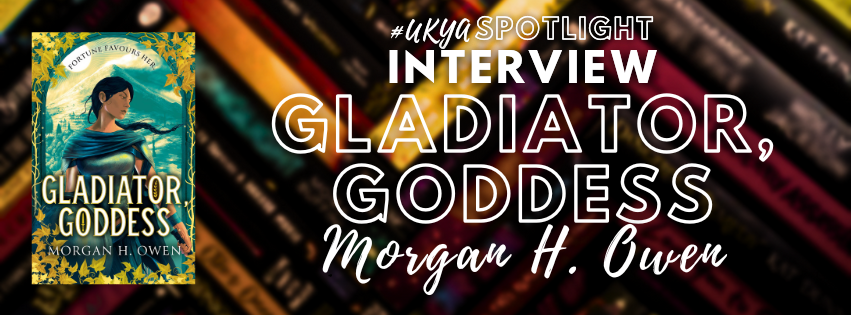
About the Book:
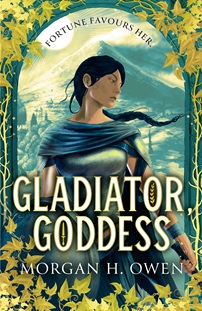
The Roman Goddesses have grown weary of the rule of Gods and men. They seek to change the fortune of the world by backing a brilliant young woman.
In Pompeii, Gia dreams of being a female Gladiator, but there is no such thing. When she wins the favour of Claudia – the beautiful daughter of the Emperor – her star begins to rise in the arena, but so does the risk to her life.
Together, the girls must battle conspiracies to overthrow the Empire, and their growing feelings for one another. Feelings the Goddesses had not planned on.
Find this book on Goodreads and Bookshop.org UK (affiliate link)
About the Author:
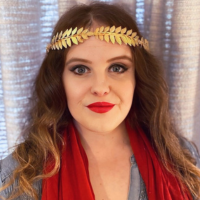
Former Waterstones bookseller Morgan Owen lives in her own little world, but which world in particular depends on the day. A lifelong fan of escaping reality, she was first published at the age of 12, reviewing the Tom Cruise fan club website (it was okay). She regrettably didn’t graduate from Birmingham University but she’s had lots of different jobs, including as a music journalist and a film PR executive. Morgan is amicably divorced from her American ex-wife and has two black cats called Salem and Binx. Her passions include pop culture, cosy gaming, retrofuturism, space and lucid dreams.
Interview:
What is it, do you think, that fascinates us with the ancient world and, in particular, Pompeii?
For me, there’s a ‘This Could Be Us’ angle to studying ancient history – I love to imagine what might be the tipping point of our own civilisation, or which modern buildings would become ruins to be studied by future history students. We look to the past to predict the future. There’s a universality in the human experience, too. When I read ancient Pompeiian graffiti about sex, heartbreak, poverty and politics, it feels like time works in circles. With Pompeii, that same force that buried the city also preserved it from the ravages of time – which is why I think it holds a particular fascination. It’s a kind of historical time capsule.
This book is told from Gia’s perspective. Did you ever consider telling it from both girls’ perspectives, or did you always know that you would follow only Gia through the tale?
Bit of a spoiler here but the second book in the duology will be written from Claudia’s perspective. I did the same thing with my first duology (The Girl With No Soul series) because I love switching point of view; it breathes new life into the story and opens up the field. I get to play with subjectivity and memory. I’m excited for readers to see Gia through Claudia’s eyes, and to get a better look into how Claudia’s mind works as they attempt to rewrite history.
Gia and Claudia’s relationship involves Gia realising for the first time that liking girls is as much an option as liking boys, which felt very reminiscent of the Section 28 era. Why is it important that books for teens today, who haven’t grown up under Section 28, are exposed to tales where there is a similar restriction on information – formally or otherwise within a world?
As a YA writer I’m obsessed with awakenings and coming of age stories but history also repeats itself. The right-wing is targeting minority groups. Attitudes towards queer people are shifting. The trans community is under attack. Book banning is back in fashion. The United States seems close to enacting its own Section 28. This might seem like an American problem right now but with the rise of British populism, it might be a contemporary problem for us too. I don’t want young people to grow up in another era where censorship breeds ignorance.
If you had to be a gladiator, which type would you like to be?
The type of gladiator I’d like to be would be a retarius, because they get a cool trident and a net, maybe even a nice fish engraved on my helmet, but the type of gladiator I’d actually be is a dead one. I wouldn’t last a single match, even if it wasn’t a kill to win game.
What fact surprised you the most from your research?
I’m fascinated by the way Roman society normalised male homosexuality while denying lesbianism. Rome was all about male power, so emperors taking male lovers was part of that patriarchal culture. There were many words for different dynamics between queer men, yet there’s barely any evidence of women loving women – though we know it existed through these historical fragments: graffiti, a bathhouse painting, a certain fresco of the poet Sappho. Uncovering that hidden history was one of my favourite parts of writing the book.
There are four goddesses scheming to thwart Jupiter and therefore helping Gia and Claudia. Why did you pick those four? Was the identity of the rebel goddesses ever in flux?
The sections with the goddesses came later, after I’d already written the mortal part of the plot. My first draft of GG had the pantheon in the background pulling strings but essentially unseen. Bringing them onto the page transformed the story. At that point, Fortuna was intended to be the main player, because she’s a uniquely Roman goddess. The trio of Minerva, Venus and Diana made sense to me as each of these deities have been depicted as a warrior. Minerva is a military tactician. Diana is a hunter. For Venus, the goddess of love, the battle of the heart is the greatest war of all.
Being a gladiator was a brutal life and this book does not shy away from that. There’s quite a high body count – inside the arena and outside. Did you ever want to save any characters you ended up killing? Is there anyone you thought you’d kill but didn’t?
My answer to this question is a spoiler but there’s a character who was very much dead until the last draft, when I had a last-minute flash of inspiration and decided to resurrect them. They had a very close call. There are a couple of characters I still feel guilty about killing off but I felt I had no option to save them in the circumstances. It wouldn’t feel right to tell a Pompeii story without accurately depicting the devastation and tragedy of that day in history.
Please can you recommend a UKYA book you think readers will love:
The End Crowns All* – Bea Fitzgerald: classic, sapphic, dramatic and romantic – everything I love in literary form
Thank you, Morgan!
*Affiliate link
 #UKYASpotlight
Leave a comment