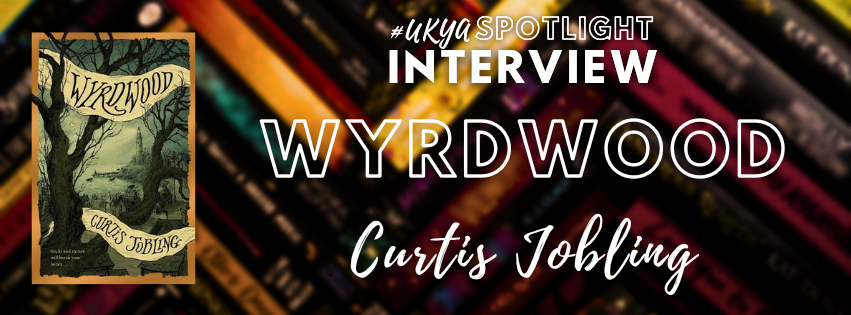
About the Book:

Something strange is happening in Merryweather-by-the-Sea.
Whispers in the playground abound – a spring-heeled phantom haunts the edge of the Wyrdwood, the ancient forest which surrounds the sleepy coastal town. But the Twig Man is the least of Kiki Harper’s concerns.
Returning home for the holidays, Kiki discovers a peculiar woman has moved into her family home, having stolen everybody’s hearts. Who is the beautiful Fay – and could Kiki’s family really be bewitched?
Find this book on Goodreads and Bookshop.org UK (affiliate link)
About the Author:

Curtis Jobling is the designer of worldwide hit children’s television show ‘Bob the Builder’, and the author/illustrator of numerous children’s books. He lives with his wife, Emma, in Cheshire, England, along with a menagerie of children and pets.
Although renowned for his work in film & TV, Curtis’s true love has always been horror and fantasy for older audiences. The million-selling ‘Wereworld’ series of novels has been adapted into a major new animated show for NETFLIX, titled Wolf King and produced by Lime Pictures and Jellyfish Pictures.
Interview:
Merryweather is very much a place out of time, an isolated fishing community with the sea on one side and the forest on the other. How did you approach building the atmosphere? Did it evolve over the course of edits?
Funny you mention that it’s a place out of time. There are plenty of remote villages around the British Isles that feel like Merryweather-by-the-Sea – I think I’ve holidayed in most of them as a child. It’s based (super loosely) on a number of places like Robin Hood’s Bay, Clovelly, the Isle of Man, all of which I have a personal and familial connection to in one way or another. There are even nods to the village of Carlton Husthwaite in North Yorkshire where my wife and I first lived with our young family – our home was The Reading Rooms, right on the village green. As for the atmosphere, the location is just like a character; it has to feel alive, lived in, and my job as the author is to ensure that happens.
You play a lot with family dynamics within Kiki’s family. Fay is an almost evil stepmother like figure. Her aunt is involved. How did you go about crafting these dynamics?
There are a great many blended families out there today. The 2.4 children “nuclear families” are a thing of the past. I wanted to ensure the Harper family reflected that. And it’s nice to set up those dynamics early, fractured and fraught as they are. It’s never easy for kids when an adult moves into the home in the role of parent or carer to them. Fay is no different in that regard, and Aunt Clara’s place in the Reading Rooms is naturally threatened too. Clara let’s her fears be known by her actions. Conflict makes for drama.
In contrast to the younger characters, the town elders are incredibly guarded, clinging to traditions without any explanation to the young. Do you believe there’s a real need for us to balance tradition with progress in everyday life, rather than the relentless progress pushed by big tech?
*checks his own age* I think I’m classed as a town elder myself these days, and I certainly push back against technology, either willfully or through ignorance (ask my kids). Wyrdwood is a folk tale, a folk horror, and as such would be nothing without a healthy dollop of tradition and superstition. I guess the trick is separating the wholesome and worthy traditions from the unhealthy and toxic ones; perspective is everything. There’s a small portion of society out there, the Boomers, call them what you will, who instinctively cling to tradition, even if it’s hurtful or distressing to minorities. Empathy is thin on the ground there. But the kids are the future, and they know where it’s at; the kids are alright.
The book draws heavily from British folklore and especially its emphasis on the natural world. What lessons do you think there are for us from our folklore’s focus on nature?
It comes back to Jacob and Wilhelm Grimm for me. Pretty much all of their tales involves the woods and the forests, with the message of “trust nobody and stay away from the dark and wild places”. These weren’t cozy bedtime stories; they were cautionary tales, with their roots buried deep in Germanic folklore. There’s wilderness on your doorstep wherever you live in the UK – walk far enough in one direction and you’ll find it. Sure, it may not be populated by wolves and bears – a bad-tempered badger is your biggest predatorial threat – but caught in the elements on a storm-battered moorland, being turned around in a forest, losing sight of that trail that brought you up a mountain? The world doesn’t get much older than nature itself. It’s to be respected. And for a horror story, it’s a tremendous source of fear.
Can you see yourself returning to Merryweather or are we to be left to infer fates?
Funny you should mention that. I’m not done with the Wyrdwood by a long shot…
What was your favourite moment of the story to craft, or section you’re proudest of?
As much fun as there is to be had in the moments of horror that pepper Wyrdwood, it’s the introduction of the town and its inhabitants to the reader that was the most rewarding for me. I’ve seen some lovely reviews about the very real impression Merryweather and the locals have made upon readers, and there’s no better praise for a fiction writer than to be told their characters are believable. I’m a big fan of the small-towns New England fiction of Stephen King, particularly those towns like Castle Rock and Derry that he’s able to conjure, where there’s a secret hidden behind every door and window shutter. Hopefully there’s a bit of that in Merryweather too.
How has your experience working on screenplays affected your writing process for novels?
I’ve had a varied and interesting career in both broadcasting and publishing, and I’ve always been able to change gear between the two, and working with different audiences also. As a huge fan of horror and fantasy fiction (and cinema) there’s an element of that in all of my writing. I grew up on Star Wars and Flash Gordon, The Lord of the Rings and Dungeons & Dragons. If I’m guilty of anything, it’s that I love a good cliffhanger. I want the viewer to stay tuned in, the reader to keep turning the page… just one more chapter…
Please recommend a UKYA read you think readers will also love.
It has to be THE LORD OF THE FLIES*. It was the first “disturbing” book I read as a young teenager, and seeing the fate that lay in store for a group of kids that I could relate to was pretty damned terrifying. The lengths and depths the boys go to and delve into in order to survive absolutely blew my mind. Swallows and Amazons it most certainly isn’t.
Thank you, Curtis!
*Affiliate link
 #UKYASpotlight
Leave a comment