About the Book:
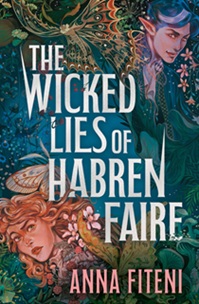
Ceridwen Parry has run away with the fairies. But this is not her story.
For Sabrina Parry, the world is tough, cruel and practical. With her father in prison, her aims in life are: 1. hold onto her job, 2. hold her tongue and 3. set up her sister Ceridwen with a man rich enough to look after her.
Ceridwen is lovely, romantic, timid – everything that Sabrina isn’t. But then Ceridwen vanishes into the eerie woods leaving only an iron ring behind and Sabrina is drawn into a beautiful but decaying world of fairies and monsters of old. And when an annoyingly handsome fairy prince offers her a dangerous deal, Sabrina is forced to put her own freedom at risk to save her sister.
Find this book on Goodreads and Bookshop.org UK (affiliate link).
About the Author:
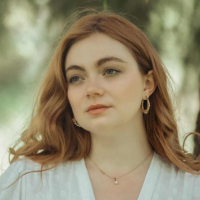
Anna Fiteni is an author from Wales. She studied English and Creative Writing at the University of Warwick, before going on to the University of Oxford to complete a PGCE. When not writing, Anna enjoys travelling, fashion history, and daydreaming about writing.
Interview:
THE WICKED LIES OF HABREN FAIRE is steeped in Welsh folklore. Were there any creatures you wanted to include but couldn’t fit in?
I wanted a dragon! In hindsight, given our flag, it feels kind of cheeky that I didn’t manage to get y ddraig goch in.
The book begins in our world in 1842. What drew you to this era as the period for Sabrina and Ceridwen to come from?
I picked that year because I wanted to talk about the Rebecca Riots. I think they’re a really interesting moment in history, not just in the history of Wales, but in the history of workers’ rights in general. I learned about them when I was young from a display in Saint Fagan’s Museum and the story and image of a burning tollbooth set alight by men wearing women’s traditional dress really stuck with me. On a practical level, the riots gave me a good way to get Sabrina and Ceridwen’s father out of the way so the plot could happen, and also let me show from the start of the book that the whole Parry family has a bit of a revolutionary streak. I actually hate 1840s clothes though, it’s up there with the ugliest fashion period of all time for me, so I was a bit disappointed that I had to use the 1840s.
Your Eu Gwald (fairyland) employs the familiar idea of time being different inside than the ordinary world. However, your Eu Gwald unusually sees Sabrina meet people from the future (relative to her) not just her past. What led you to have time be permeable both ways?
Honestly, I’m not sure! I think it might have come from a ghost story I heard as a kid about soldiers roaming around the woods that was the site of the only battle of the English Civil War to be fought in Wales. When I was thinking about Welsh folktales, that one’s always stuck with me, especially because I just really love ghost stories, and so many of them come with the image of a person being stuck in time while everything else moves on. I made my ghost a World War One ghost though, because I don’t know much about the English Civil War.
The main themes of this book are, for me, mortality and time, and what we do with the time we have, and I liked the idea of Sabrina and Ceridwen being too modern for the time they’re in, because I think there have been lots of women like that throughout history. There’s a poem called Welsh Landscape by R.S. Thomas which has this line that’s always been stuck in my head: ‘There is no present in Wales, And no future; There is only the past’. Growing up in Wales, you’re surrounded at all times by castles and echoes of a past that seems far grander than it probably was, contrasted with a present that’s rather bleak, and no one seems able to think of a way to make a better future. Everyone’s always talking about the past, and the mistakes that got us to the point we’re at now. I suppose I wanted to introduce Sabrina from the past and the future to show that while both are important, she can never go back, only forward.
Neirin is the epitome of charming fae who cannot lie but is most certainly not being entirely truthful. What do you think draws us to these characters are romantic interests?
It’s the guyliner and the fantasy elements, right? Like, I would not be happy with the nonsense Neirin pulls in real life, but in fiction we can play around with complicated ideas about romance, and it can make the love interest a more interesting character. In this book, I think the bad things about Neirin are what make him a good match for Sabrina, because they have the same flaws, and recognise and understand that in each other. It could also be the fantasy of men being utterly awful but then actually learning from their mistakes and apologising.
The ending is so good, tying the troubles of the Eu Gwald to the exploitation of Wales by the English. Did you always know exactly how the ending was going to play out plotwise or did it change during the course of writing and editing?
I knew the beginning and ending from the moment I first got the idea for the story, and very little changed. At one point the sections in the mine were longer and some action scenes were cut, but the essence of the ending has always been the same. Though I focused on Wales’ history, the same exploitation of the working class has happened and continues to happen all over the world, so while the ending was very personal for me, as a Welsh writer, I hope it connects universally with readers.
Sabrina’s final decision is not perhaps the most typical – but one that felt perfect for teen readers. Did you ever contemplate giving her a different choice?
Not at all, honestly. Though I know her decision has caused a variety of emotional responses for readers, it was important for me to give Sabrina an ending that felt both true to her character, and also to what I believe, which is that your life gets infinitely better after sixteen, so long as you go and find it for yourself.
If you had to venture into Eu Gwald, how well do you think you’d fare?
Probably very poorly! All of Sabrina’s flaws are my flaws, I’m very argumentative and competitive, so literally any trap she fell into would probably get me too. Also I do not have the will power to walk through that much forest. I hate mud. I’d probably just lie down and die in the moss or willfully eat some cursed fairy food to get me out of having to ever go on a quest.
Please recommend a UKYA read you think readers will also love
MOONSTONE by Laura Purcell* – Purcell has been one of my favourite authors for years, and I loved her YA debut! It’s gothic, atmospheric and romantic
Thank you, Anna!
*Affiliate link
 #UKYASpotlight
Leave a comment