About the Book:
When fame tastes sweet, how far can you go before it
turns sour?
With AI influencer robots taking the internet by storm, Mikah and his friends team up to make their own content. No robots, no AI, just human beings in all their fallible glory.
Mikah’s mukbang channel where he stuffs his face with food soars to great heights, but what will happen when his body can no longer fly?
Blurb taken from Goodreads. Add to your shelves here. Find on Bookshop.org UK (affiliate link).
About the Author:
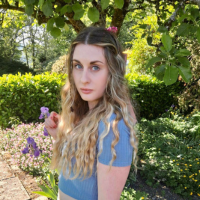
Monique Turner was raised in the cold North of England on a diet of thick gravy and strong brews.
She trained to be an actress and began drafting her first novel in 2016 whilst awaiting feedback from an audition. Sadly, she didn’t land the acting role, but during the creation of an epic fantasy world, she realised that she’d found her true calling in fiction writing and hasn’t looked back since.
Now living in the South of England, Monique Turner can usually be found roaming the Dorset coastline, exploring ancient woodlands, or trying desperately to befriend the bees in her garden.
Interview:
Pitch your book in 10 words!
Mukbang creators prove human suffering more entertaining than AI content.
What led you to choose mukbang as the content type Mikah does, and to lean into the “eat all you possibly can” version?
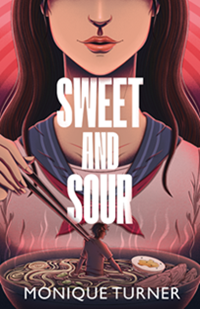
We’re all starving for purposeful entertainment. When I was developing the plot for SWEET AND SOUR, I was surprised by how popular mukbang content had become. The movement began in South Korea to help alleviate loneliness in the country, but over the years, the trend became westernized and is now less about building a community and more about theatrics. The whole concept of this book is based on how we consume media, so mukbang was the perfect metaphor for fame and the audiences’ insatiable hunger for more than an artist can give, which I think is beautifully represented in the cover art by Ali Al Amine.
Mikah is a complex character for all that he has a simple aim, but his insecurities really affect his perception of what’s happening. What was the attraction of an unreliable narrator?
Mikah’s insecurities were based on my own from when I was younger. Before I was a writer, I was a theatre kid. Being on stage enabled me to be someone else for a while, someone with confidence. I gave Mikah the same experience I had growing up for a bit of catharsis and to prove that insecurities don’t have to hold you back from achieving your goals. He’s a paradox; he wants to create but fears being seen, just like me. I wanted to reflect the complexities of human nature in my characters because it’s real, and real life is messy and full of paradoxes.
The current trend is for books to feature characters falling in love and deciding whether or not to start a relationship. Instead, you look at the pressures a situation like this would put on an existing one. What prompted you to spotlight this less commonly talked about stage of a relationship?
We often read so much about the beauty of falling in love because it’s easy and fun, but most people have no idea how to stay in love when life gets tough. We all want that one person to stick by our side and help us through our dark days, but that’s usually the time most relationships fall apart. In SWEET AND SOUR, Mikah and his girlfriend, Isobel, reach a difficult stage in their relationship when their desires, goals, and expectations aren’t aligning. Feelings get hurt, but with good communication, empathy, and compromise from both parties they manage to work through their struggles, and their bond strengthens because of it. I’ve never been one to shy away from the difficult parts of life, in fact, I tend to run toward them, which is probably why this less commonly talked about stage of a relationship interested me most. You can’t truly meet yourself until you’ve faced your own darkness, likewise you don’t really know someone else until you’ve sat with them through theirs.
Mikah and Zach’s friendship is just as central to Mikah’s mental state as his romantic relationship with Isobel, and it comes under just as much strain – this time due to the pressures of society’s male gender roles. How do you think social media heightens these pressures and why did you choose to explore this through Mikah, someone who doesn’t fit a typical male influencer mould?
I’m perpetually frustrated by the performative nature of social media and the pressure placed on us to look a certain way, think a certain way, and live a certain way. The antagonist, Anna, is representative of an insidious movement to create the ideal version of a human, and Mikah and his mates are fighting against that. So, it was important to me that Mikah represents the everyman, the guy who’d typically be overlooked.
In SWEET AND SOUR, Zach is conventionally attractive and full of confidence, the typical male influencer stereotype. Mikah is super insecure, sensitive, and needs a lot of reassurance, all the things that boys and men are typically told not to be. For their online channel, Digital Demons opt for anonymity by wearing masks. For Zach, this is catastrophic because he doesn’t know who he is outside of his good looks, whereas Mikah’s insecurities are alleviated and his personality and tenacity push the channel to success. This causes a lot of animosity and jealously between the boys. It was an interesting dynamic to play with and an important one in the effort to help dismantle very damaging male gender stereotypes.
Looking at the world of content creators and influencers allows you to explore the parasocial, often obsessive, nature of fandom and the pressure and stress that it causes each of the Digital Demons. What lessons do you think society should be learning about intervening and supporting both parties?
It’s incredible how one artist, creator, or idea can bring together a community of likeminded people, but it’s also fascinating how hive mind manifests in such a claustrophobic environment. The artist/ fan dynamic is stressful for both parties. The artist suddenly has an army of strangers speaking on their behalf, oftentimes oversexualizing them or infantilizing them to the point where they lose their own identity outside of their work, and the fans become so consumed with the artist’s life and work that they often forget it’s a one-sided relationship.
We hear so many horror stories of artists abusing their power over fans, and just as many about fans crossing boundaries with artists. Really, it comes down to us as individuals and how we choose to conduct ourselves. With power comes responsibility, and artists have a duty of care toward their fans to maintain strict boundaries to keep the relationship professional. Fans must retain a healthy level of discernment to understand there is no real relationship between them and the artist beyond creator and consumer.
Enjoying something or having a degree of admiration for someone is normal, but becoming obsessed to the point of stalking, doxxing, and attacking isn’t. As a society, we need to talk more openly about the artist/ fan dynamic and recognise when it’s necessary for therapeutic intervention. It’s not about “clowning” on anyone who becomes obsessed with an artist but helping them understand why it’s happened and how they can recentre their inner worlds.
Over the course of writing and editing this book, were there any developments in AI and corporations’ drive to get people using it that influenced or changed sections of the story?
Truthfully, I had a vision from the start and I didn’t want any outside influence to interfere with or change that, so I pretty much had my head down from the first draft to the final, and the story didn’t change much during that period. However, I did stumble upon an AI mukbang video quite early on and both my editor and I sent it to each other almost simultaneously. That spurred me on because it amplified my anger at seeing something as human as eating being simulated by AI. In July, when I was handing in my finished manuscript, the first AI actor was introduced to the public, again just reinforcing what I was writing. From December 2024 to July 2025, AI shifted in its capabilities from being a predictive tool to making informed decisions without human approval. SWEET AND SOUR might be a work of fiction, and the plot sometimes sounds far-fetched, but it’s very much our reality.
There are a few Easter eggs in this book to your debut, ISLAND OF INFLUENCERS. What were some of the challenges and advantages of having both books share the same world?
I wanted both books to connect but also to act as standalone novels. They complement each other but it’s not necessary to have read ISLAND OF INFLUENCERS* to understand the plot or themes of SWEET AND SOUR. I loved being able to expand the world without being restricted by the view of a single character, making it feel more lived in. However, the challenge came with trying to make SWEET AND SOUR different enough from ISLAND OF INFLUENCERS to ensure they could stand alone, without creating anything new that would contradict or undermine what’s already been established.
Please recommend a UKYA book you think readers will love.
A BETTER NIGHTMARE* by Megan Freeman. This story is so beautifully written and perfectly describes the haunting feeling of being a misunderstood and ostracized teenager just trying to find their place in the world. The author creates such a dark and moody atmosphere that also somehow feels like home and she had me rooting for the escape of the characters from page one.
Thank you, Monique!
*Affiliate link
 #UKYASpotlight
Leave a comment