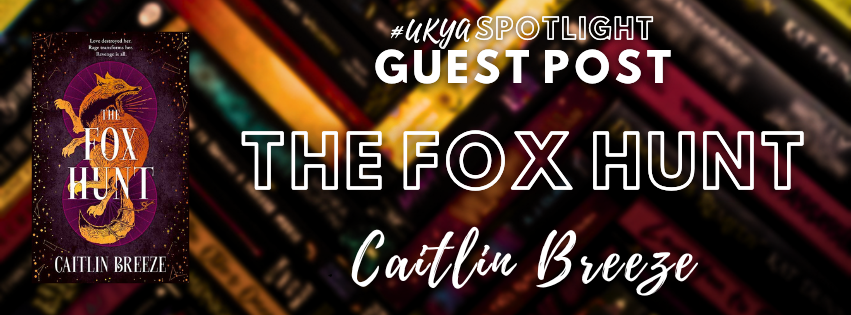
About the Book:
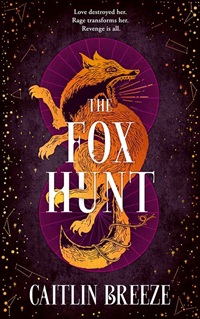
Behind closed doors at England’s most ancient university, a circle of privileged students enter into a dark pagan ritual—one that holds tantalizing power and comes at a terrible price.
When practical, unassuming second-year student Emma Curran wins an exciting research fellowship, she is ushered into the glittering debauchery of the University elite. There, she falls for the devastating, aristocratic Jasper Balfour, leader of the all-male Turnbull Club: a shadowy secret society that has created centuries of Britain’s leaders, power brokers and history-makers.
One night, the Turnbulls propose a sinister little game: a fox hunt. The women run. The men chase. And Emma finds herself fleeing for her life through the streets, hunted by the boy she loves.
Torn from her ordinary life and trapped in a dangerous, otherworldly realm, Emma awakens transformed. No longer mortal, she’s become something beastly. And now she must summon every ounce of cunning and ferocity to save herself.
Find this book on Goodreads and Bookshop.org UK (affiliate link).
About the Author:

Caitlin lives in London, in a tiny house full of books. After a BA in Classics & Modern Languages from the University of Cambridge – and a Creative MA from Falmouth University in Cornwall, her favourite corner of the world – she currently works as a creative director. The Fox Hunt is her first novel.
Why Secret Societies Have Us Hooked
The first time I met a secret society, I was nine years old and hurrying after Sherlock Holmes. I was reading The Five Orange Pips, one of Arthur Conan Doyle’s short stories about Sherlock Holmes’ cases. In it, a man receives five dried orange pips in an envelope. It’s a warning. Soon after, he dies. Sherlock Holmes explains that the symbol comes from a secret organisation the man had once been involved with overseas. He had been marked from the start.
It was deliciously chilling. The idea that somewhere there were people who could decide your fate without you even seeing them. Across oceans and continents. Invisible and shadowy, they had power that ordinary people didn’t.
What fascinated me most wasn’t the secret of who they were. It was how they had that power in the first place. That question helps explain why secret societies show up again and again in stories. Psychologists who study secrecy say that humans are naturally drawn to things that are hidden. When something is restricted, it feels more valuable. We also have a deep need to belong. So when we see a closed group, part of us wants to know what it would be like to be inside.
That curiosity is still with me, at least. And I think I’m not alone. Secret societies never go out of style in stories. In Victorian adventure literature, they show up as thrilling adversaries: usually foreign entities, who can reach across borders to brutally murder former members who have dared to betray them, even when they’re back on ‘safe’ British soil. These stories often reflect fears about power: how much of it rested overseas at the time, and how much foreign influence might both threaten and infiltrate British power. In Wilkie Collins’ The Woman in White, Count Fosco is hunted across Europe by an Italian Brotherhood he has betrayed, ending his days in a Paris morgue, marked by a strange symbol.
And that childhood Sherlock Holmes story? The foreign secret society sending orange pips was, in fact, the Ku Klux Klan. I didn’t realise at nine that I was reading one of the earliest fictional appearances of a real and deeply violent racist organisation. What I absorbed instead was the mythic version of it. Stories about secret societies reflect both the real world and our deep-seated feelings about power, and who holds it. Arthur Conan Doyle was not the first to look at a real-life secret society and decide to use a story to express his unease at the amount of power they held.
Secret societies aren’t always written as villains. Sometimes they’re protectors. In Legendborn by Tracy Deonn, a hidden campus society descended from Arthurian knights secretly fights demons. In Cassandra Clare’s City of Bones, the Shadowhunters defend the human world from supernatural threats while remaining largely unseen. In these stories, secrecy feels thrilling rather than frightening. The idea that someone powerful is managing the darkness can be comforting.
But often, tales about secret societies are about our draw to the darkness. They follow characters in danger of being consumed by their desire for power. And that’s why secret societies feel completely at home in dark academia.
Elite universities already come wrapped in tradition, ritual and exclusivity. They promise transformation, but not for everyone. Adding a secret society to that setting gives fiction a magnifying glass to bring these underlying dynamics into sharp focus.
In the original story of dark academia, Donna Tartt’s The Secret History, a small classics group isolates itself intellectually and morally from the rest of campus, with catastrophic consequences. In Leigh Bardugo’s Ninth House, Yale’s real-life secret society Skull and Bones becomes part of a network performing dangerous occult rituals. Academic prestige is transformed into literal supernatural power.
Sometimes, though, reality doesn’t need magic to feel dramatic. Take the UK’s most famous university society: Oxford’s Bullingdon Club. Founded in the eighteenth century, it became known for extravagant dinners that ended in destruction. Members wore distinctive tailcoats and were often known for smashing up restaurants, and later paying for the damage. Several members went on to become major political figures. The club isn’t technically secret, but it has come to symbolise elite privilege and the protection that can come with wealth and connections.
And that might be why it’s such a fertile ground for fiction Evelyn Waugh’s Decline and Fall satirises the Bullingdon as the Bollinger Club, whose reckless behaviour leaves others to deal with the fallout. In Anatomy of a Scandal, the shadowy Libertine Club shapes political careers and has the power to hush up scandals. Posh by Laura Wade, and its film adaptation The Riot Club, follow a fictional Oxford dining society whose members believe they are destined to rule Britain. At one point, a character bellows, “We are the future of this country.” The club members’ confidence slides into entitlement and cruelty.
All of this fed directly into why I wanted to write The Fox Hint. I’m fascinated by how power can gather in small, exclusive groups.
I love universities. I love old libraries and traditions and the idea that knowledge can transform you. But I’m also interested in what happens when power concentrates in small, closed groups. In my novel, the Turnbull Club is a secret society of wealthy young men at an ancient university. They believe they are destined to lead. When my heroine becomes entangled with them, they believe they have the right to dispose of her as they wish.
But the story isn’t about her staying powerless. It’s about her fighting back.
Instead of trying to break into their circle, she builds her own support system through female friendship. The bonds she forms with her new friends become just as strong as the inherited networks that once kept the Turnbull Club untouchable.
I hope readers will follow my heroine into her battles with her secret society opponents, and take away one key thing: we have the power to create an alternative to old boys’ networks. Through our friendships and loyalties, we can champion everyone’s right to succeed, rather than the rights of inherited privilege. Because together, we’re as powerful as any secret society.
Thank you, Caitlin!
 #UKYASpotlight
Leave a comment