About the Book:
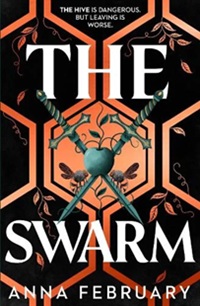
Royal maverick Niko and bodyguard Feldspar have been tasked by their queens to lead a swarm – an exploration – in search of a new world outside their twisted monarchy.
What they find beyond the Hive is a paradise – but is it
too perfect to trust?
When two brutal murders happen on the same night, the royal visitors are the prime suspects. With danger closing in and their feelings for each other growing, Niko and Feldspar must fight to clear their names before paradise becomes a prison …
Find on Goodreads. Find on Bookshop.org UK (affiliate link).
About the Author:
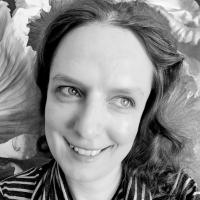
Anna February wrote her first book at the age of six and has been writing ever since. By day, she works as an editor of teaching materials for STEM courses at The Open University; by night, she is an author of speculative fiction for young adults. Although she spends the vast majority of her time trying to arrange the right words in the right order, her other interests include drawing, board games and large amounts of chocolate. She also writes books for older readers under the name A.F.E. Smith.
Instahttps://www.instagram.com/anna.february.author/gram
Interview:
Pitch your book in 10 words!
Discovering a new colony is paradise … until the murders start.
How soon into the process of writing THE HIVE* did you have the idea for THE SWARM? Has it changed much since then?
It’s hard to have any fixed plans for a sequel until the first book has gone through editing, because the changes made during the editing process can affect the sequel significantly. But I always wanted Niko and Feldspar to leave the Hive. The first book shows that there’s life outside their colony, so the question immediately becomes: what sort of life is it? It would have been a shame not to answer that. Yet I also didn’t want to ignore the Hive completely in this book, because certain elements of its future were left unresolved at the end of the first. So there was a lot to fit in! The finer details of the idea changed over time, but the key events remained the same.
This is our second outing in this dystopian world of bee-like colonies, but this time we visit a new society, Siguria. It’s a far nicer society than the Hive, but has its own flaws. How did you decide where to strike the balance between utopia and dystopia with Siguria?
Siguria is largely utopian for two reasons.
First, I wanted to strike a more hopeful note for us as a species. THE HIVE showed what happens when people attempt to create a better society but let fear and greed shift them back into old, harmful patterns of exploitation and xenophobia. THE SWARM is intended to show that it is possible for us to get it right – that even in the face of catastrophic natural disaster, it’s never too late.
Second, it was important for Siguria to be amazing because Niko is telling the story, and Niko hates the Hive. So discovering a colony where science is respected and people are all treated as equals is a highly vindicating experience for him, because it validates what he’s believed all along – but unfortunately, that also blinds him to the possibility that it’s not a perfect world.
And that brings us to the dystopian element! My belief is that, just as there will always be people striving to do better and make a difference in even the most dystopian society, there will always be people who seek to turn the most utopian society to their advantage – whether that’s through selfishness, cruelty or a misguided belief that they’re in the right. That’s just human nature. I don’t think it’s possible to create a world that’s either wholly dystopian or wholly utopian. Our responsibility is simply to get as close to utopia as we can.
The societies in this world are related to bees. Is there a fact or aspect of bee-ish life that you wish you’d been able to weave into the tale?
My favourite fact about bees is really nothing to do with the bees themselves, and wouldn’t have fit into the story at all: there is a network of wildflower-rich habitats across the UK, known as B-Lines, that create pathways for bees and other insects to travel around safely. Since both our biodiversity and our pollinators are under threat, this is really important work to support the natural environment. If you’re interested, you can find out more at https://www.buglife.org.uk/our-work/b-lines/.
The narrator this time is Niko. What was it like writing in this world from another perspective? Was it easier or harder than you expected?
Writing from Niko’s perspective in itself was easy, because Niko is the sort of person who simply can’t switch off his thoughts. He can never just rest, because his brain will be churning away with theories or worries or random facts he read five years ago and doesn’t have a use for. And I’m like that, too. I’m probably more like Niko than I am like Feldspar. So tapping in to his point of view wasn’t a huge leap for me.
The difficult part was writing Feldspar, because we’d already seen inside her head in THE HIVE. Taking a character whose internality we previously weren’t privy to, and opening him up – that’s an expansive process. But taking a character whose thoughts we used to experience, and now viewing her solely from outside – that’s a closing-off. So if anything, I had to try harder to write Feldspar than I did to write Niko, because I had to make sure she still seemed like herself even without the benefit of being able to convey what she was thinking this time round.
Niko and Feldspar return as core characters but much of the remaining cast are new characters – reflecting the new adventure and location. Do you have a favourite new character?
I have a huge soft spot for certain soldiers among the group who are sent with Niko and Feldspar to Siguria, but since all of them become the main suspects in a murder shortly after they arrive, I can’t really say who without it being a massive spoiler.
Other than them, my favourite character is probably Jay. He’s the son of the leader of Siguria, yet his experience of that status is wildly different from Niko’s. And he plays a huge part in Niko’s character development in the book, as a fellow scientist and a model of healthy family relationships, but most importantly as a friend. We saw in THE HIVE that neither Niko nor Feldspar has really ever had a true friend before meeting the other, but at the start of THE SWARM we learn that Feldspar has developed friendships with several of the girls – whereas Niko still feels quite isolated. Making friends with a boy of his own age is such an important step for him. And Jay is a great friend.
(Disclaimer: none of this is to say that Jay may not also be a murderer. As always, everyone’s a suspect!)
Dystopia is having a comeback almost ten years after its last big moment. Why do you think dystopias are particularly popular with YA readers?
Well, the real world is feeling increasingly dystopian, isn’t it? Young adults in particular are facing what can seem like a pretty bleak future: climate change, extinct species, leaders who prefer war and brute force to cooperation and problem-solving, all the wealth and resources in the hands of a few billionaires, AI taking the place of human creativity and replacing human jobs … the list is overwhelming. And I think one of the most powerful things we can do in that situation is read stories about people in similarly daunting situations who, nevertheless, don’t give up. Who keep striving to make the world a better place. Who lose neither their hope nor their sense of morality, even when everything around them seems determined to destroy both. Stories like that show readers that they as individuals can make a difference – and that’s what we need, above all, in times like this. Hope, and the belief that we can make a difference.
Please recommend a UKYA book you think readers will love.
SWEET AND SOUR* by Monique Turner – a dystopia that explores the impacts of AI and social media on humanity. It reads like Black Mirror in written form and provoked a lot of discussion between me and my 13-year-old son. (Sometimes I find it hard to identify books that will appeal to him, but he loved this one.)
Thank you, Anna!
*Affiliate link
 #UKYASpotlight
Leave a comment