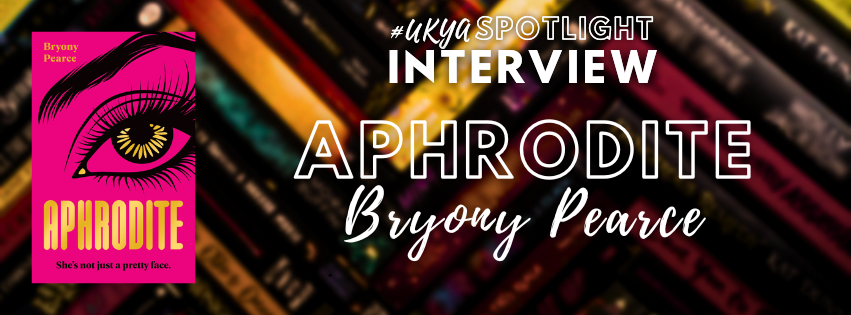
About the Book:

From award-winning YA author Bryony Peace comes a deliciously feisty feminist Greek retelling.
Beauty isn’t everything, but love might be. She’s just the Goddess of Love and Beauty. And that’s exactly what she wants them to think.
Naked and salt-soaked, Aphrodite is born from the waves. Knowing nothing of who or what she is, she quickly discovers that she has incredible power and the kind of beauty that makes men mad. Her blood pulses with the same call: home, home, home.
Cue Olympus, the home of the gods. But Olympus turns out to be a seething snake-pit, and love is never simple. Ordained the mere Goddess of Love and Beauty, the threatened and spiteful gods and goddesses seek different ways to control Aphrodite. As a trap closes in around her, she learns that it is a curse to be seen as nothing but beautiful – but it may also be her strongest weapon. The gods of Olympus will soon learn not to underestimate the Goddess of Love and Beauty.
Add this book to your Goodreads shelves here. Read Sifa’s review here and Beth’s here. Find this book on Bookshop.org (affiliate link).
About the Author:

Bryony Pearce is a multi-award-winning novelist working in both the YA and Adult markets. In the YA genre she has produced a mixture of dark thrillers, paranormal adventures, dystopia and horror. Hannah Messenger is her middle grade debut.
Bryony teaches the course Writing for Children at City University, regularly visits schools to speak about reading and writing and conducts creative writing workshops, as well as delivering entertaining and inspirational talks. She has performed at the Edinburgh Literary Festival, The Wychwood Festival, Comicon, YALC, the Sci Fi Weekender, The Just So Festival and a number of other festivals and events.
Interview:
We loved how you played with the Hesiodic and Homeric tales. There are so many myths out there, and so many versions from the centuries of development. How did you approach sorting out which parts to include, which parts to twist, and which to discard? For example, you use Atalanta as a key part of Aphrodite’s journey while touching lightly on the better known Paris (and thus the Trojan War).
One of the reasons I chose to focus my novel on the myths around Aphrodite was the ambiguity surrounding her birth, as highlighted by Hesiod and Homer. In Hesiod she is the daughter of Uranus, born from the semen spilled from his severed genitals when they were dumped in the sea. In Homer she is, much more boringly, the daughter of Zeus and a nymph, Dionne. I loved playing with the confluence of the two ideas, so I made her the daughter of Uranus, who comes to believe she is the daughter of Zeus, who sees her as a threat to his power and seeks to control her via the medium of the family she is missing – offering himself as father and patriarch.
In reading the myths surrounding Aphrodite I noticed certain recurring themes: the apple (which appears in her visit to the Hesperides, the story of Atalanta and the Trojan War) and the sea. So the myths I chose to focus on contained those themes, and enabled me to pull together a cohesive story from the pantheon as a result.
I wanted our Aphrodite to be more sympathetic than the Aphrodite presented in Greek myths who can be jealous, fickle and destructive. For example, in the original myth about Atalanta, Hippomenes forgets to thank Aphrodite for her aid. In revenge, Aphrodite afflicts them with a passion so great that they have sex in one of Zeus’s holy places and they are turned into lions for their sacrilege. Instead of this ending, I made their transformation part of a plot by Zeus to use Aphrodite’s human feelings and trap her into giving up part of her power.
I wanted to show Aphrodite in a good light, as a goddess (and feminist icon) who is finding out who she is, so I twisted the tales in which she behaves let us say, less fairly towards women. Not because I didn’t respect the Greek myths, but because these are tales written by men. I wanted to show them as they might have been had they been written by women.
Mythologically, Aphrodite and Ares, are very undeveloped characters mostly turning up having love affairs or being humiliated; did this make it easier or harder to develop their characters as opposed to the rest of the pantheon who have well known and clearly defined personalities?
In my view the less there is about a character, the easier it is to write them. I saw these two as characters who have been ‘hard done by’ by the writers of myth and tried to see through the stories that represent them to the real people they might have been.
You have chosen to represent Ares as the most understanding – and least toxic – of the male gods. What drew you to this interpretation of the god of brutal, chaotic war and to make him such a stark contrast to the objectifying gaze of Hephaestus?
Although the myths often present Ares as a one-dimensional savage, that characterisation never made sense to me. As nothing but a violent beast, Ares would have been easily manipulated and therefore useful to Zeus, yet Zeus is always throwing him out of Olympus and, despite the fact that he is one of only two legitimate sons, Zeus considers killing him.
Homer’s Zeus describes Ares as a “double-faced liar” who is the “most hateful of all gods” who reside upon Olympus. So, I showed Ares ‘double-face’ by making him a man who hides an intelligent and poetic soul under a veneer of light-hearted humour, and extreme violence.
Ares was always designed to be the antithesis of Zeus. In Greek myth, Zeus made and enforced laws, and kept society stable. Ares was savage and wantonly violent.
However, Zeus was also destructive and lustful. If Ares is and always was his opposite, then he must represent love rather than lust and dedication to one women rather than endless affairs.
Therefore my Ares defies Zeus in his love for Aphrodite and is constant in his affection.
I love to write characters who are three-dimensional, so Ares is a man of contradictions: he loves blood and battle, he also loves poetry and sees clearly to the heart of things, including the corruption in Olympus, which he describes as a snake-pit. He has been battling with the fact that that no-one will see him as anything other than a brute. When he meets Aphrodite, she is able to see the real him, the poet, because she has no preconceptions. How could he not fall in love with her?
Aphrodite’s experience of Olympus – and that of other goddesses like Euphrosyne – is one of men diminishing their power by confining them into boxes. This sequence has her physically trapped in a palace. How did you go about crafting a story that still shows her agency despite the attempts of others – namely Zeus and Hephestus – to limit her?
I wanted Aphrodite to have great power, but not know it yet, so much of the story is about her feeling around the limitations she puts on herself, and the limits the other gods want to put on her. It is only at the end when she accepts who she really is, that she is able to break free of those limits, represented by the palace built for her, the darkness of Tartarus (in which truth is literally the only light) and her relationships with the Olympians.
APHRODITE is a book written for older teens, with a few steamier moments. How difficult was it to talk the line between YA and Adult? Were you ever tempted to write it as an adult novel?
Aphrodite is the goddess of love, so I was never going to be able to write this novel without some steam, and it was essential for the story to allow the tension and passion between Aphrodite to break and ignite (for example, in the myths, Hephaestus finds them in bed together so I couldn’t avoid that). However, I feel I walked the line between steam and erotica, hopefully satisfying readers who wanted to see the love affair consummated, but avoiding too much sex for teens who prefer a clean read.
I actually hope that adults do enjoy the novel but, to me, Aphrodite was always a coming-of-age novel, about a young woman finding her identity and place in the world, which makes it YA.
There are so many themes and ideas in the book and the tale has an open ending, alluding to the other myths around Aphrodite, inviting readers to imagine what comes next. Is there anything you particularly hope stays with readers once they finish it?
I hope readers recall Aphrodite’s power, the innocence and strength of her love for Ares and the powerless, and her ability to turn and walk away from the people who pretended to be her family, with a plan for revenge in mind.
If you could retell another myth or mythological being, which would you choose and why?
I am actually hoping that there will be a sequel to Aphrodite, called The Gift of War, in which I reimagine the Trojan War as Aphrodite’s gift to Ares, her way of calling him back to her side and her vengeance on Zeus.
If I am really lucky I’ll get to write a book three (which I imagine could be called Bad Apple) about the ending of the war and Aphrodite’s next steps into real power.
I am also interested in the Fates and Pleiades and would love to play with those, and I am drawn to the women of other pantheons. I am particularly inspired by the Egyptian goddesses and would embrace the chance to write about Isis.
Thank you, Bryony!
 #UKYASpotlight
Leave a comment