About the Book:
‘I know about the visions. I have your camera. Call me. Please.’
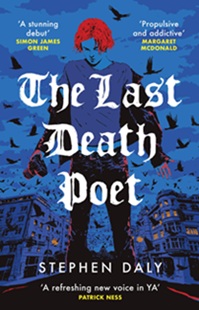
When Michael is uprooted to Belfast, he isn’t just hoping for a fresh start. He’s determined to discover the truth about his dad’s mysterious absence. But from the moment he arrives, he’s plagued with visions of the city’s troubled past.
Michael begins settling into his new life and even meets a boy who helps erase the painful memories of his ex. But as the visions grow stronger and more intense, the only person he can really confide in is his new friend Meg.
As Meg delves into the supernatural source of the visions, Michael begins to question whether events of the past are linked to his dad’s disappearance.
Can he use his powers to find his dad before he’s gone forever?
Find on Goodreads. Find on Bookshop.org UK (affiliate link).
About the Author:

Stephen Daly is a writer from a working-class community. Following his degree in psychosocial studies and MA in Creative Writing, he is interested in writing about the social and cultural issues young people experience. Stephen grew up as a queer young man during the Troubles and left the country at eighteen to try and be himself. He believes it’s time to tell more queer Irish stories. His debut YA novel, The Last Death Poet, will be published by Rock the Boat in April 2026, followed by another stand-alone YA in 2027.
Interview:
Pitch your book in 10 words!
Queer teen uncovers secrets within visions of Ireland’s troubled past.
Irish mythology is so rich – though as Meg points out, much has been lost due to English colonial policy. What drew you to focus on it as the source of Michael’s powers?
I am fascinated by mythology and folklore as a way of staying connected to the past but also understanding the people and culture we live in now. A lot of contemporary Irish culture and its people are still formed by the myths that survived. I think you can see that particularly in our relationship and customs around death and culturally our love of the supernatural: we have ghost stories and Halloween is a huge celebration. Ireland and the North has been changed by colonialism, but the old tales and myths have survived this long, and I wanted to explore how I could work old world magic into contemporary Belfast and the Troubles.
Through Michael’s visions of the past, we see over 100 years of Irish history. How did you pick which pieces to show?
There was so much I wanted to show, as this place is so full of history, but at the heart of the story is the generational trauma in Michael’s family and so I chose moments that would intersect with his family tree. I created a family tree going back to the 19th century and mapped out some key events that his family would have witnessed. I also wanted to imagine what you would go looking for if you had the power to see the past in the area around you.
Though Michael is Irish, he has lived in England almost all his life, making him in some respects an outsider. Why did you choose to explore the story through that perspective?
Tackling Northern Irish history, particularly the Troubles, is a sensitive area. On this side of the Irish sea it is highly emotive, personal, and still raw. For people in Britain it can often be a blind spot, especially for people who were born after the Good Friday Agreement. Having an outsider take the reader through the story allowed me as a writer to try and tread that balance. Michael knows as little as any reader, but his family, and new friend Meg, are there to show and tell him about the reality of life in Belfast and what it was like to live there during the Troubles and after.
Meg is such a complex character, both a much needed friend and support to Michael but also someone who continually pushes him – and not always in the best way. How much has their relationship developed over the course of writing the book?
Meg and Michael’s friendship was the most important relationship for me to get right, as it’s such an important one for Michael as a character. As a shy queer teen, Meg is that first person who Michael can totally be himself around, his first experience of found family – and Megs have been so important for me from when I was 14 right through to now. I also wanted Meg to have her own storyline, and not just be there as a source of support for Michael, I didn’t want her to just be the quirky queer girl or an encyclopaedia of Irish history. I wanted her to be as passionate, funny and occasionally self-serving as Michael was. I constantly worked at developing her character and trying to capture that time as a teenager when you make an instant best friend who just gets you. I love Meg!
Michael and other characters in the book are figuring out their queer identity and how little – or much – they wish for others to know about it. Was there a particular moment in Michael’s journey you particularly loved writing?
I loved writing the scenes in which Michael is behaving like an awkward goof around hot straight boy Paul, especially when he finds him in the room he shares with his cousin wearing shorts. Michael is quite a private person, and used to masking how he is feeling, but he constantly puts his foot in his mouth around his crush. Writing in the first person means that I got to focus on Michael’s inner monologue which could be comedically self-deprecating in lighter moments, but these times also give a window into his detrimental self-criticism that I think we can also identify with.
This is a book centred on family – the good and the bad, and how generational trauma affects us all. Why do you think it’s so important to show these complex family webs?
Well, I am from an almost stereotypically large extended Irish family, and even in a city like Belfast, many families are still very much in each other’s lives, so I wanted to capture the love, tension and humour that that dynamic brings up.
Within the context of Northern Ireland, I think we are only starting to understand the impact that the generational trauma of the Troubles will have on younger generations. The main reason I wrote the book was because I wanted to explore what young people today know about the past, but also how we can understand the emotional and psychological wounds that older generations have when they might now know themselves. Michael struggles to come out, not because he fears that his family will be homophobic, but because they are incapable of telling him the truth about the past – they don’t know how to look at it, let alone have the language to express it.
Do you have a favourite side character?
I love Michael’s cousin Cormac. He is a born entertainer, kind without trying and wants the best for people around him. He loves Michael unconditionally and is an ally, because he just treats everyone well. He was the most fun to write and represents all the decent working-class straight fellas of West Belfast who tell the best jokes, love their family and always have your back. Be more Cormac!
Please recommend a UKYA book you think readers will love.
Little Bang* by Kelly McCaughrain
I think every teen in Northern Ireland should read this. It looks at the reality of two teenagers facing a pregnancy here, exploring the stigma around teen pregnancy, the lack of safe access to abortion and gives an incredible insight into the emotional journey young women and men face when it happens.
Thank you, Stephen!
*Affiliate link
 #UKYASpotlight
Leave a comment