About the Book:
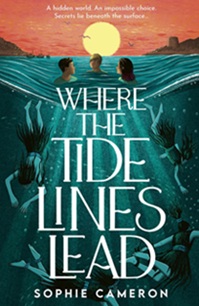
Elio’s family owns a successful holiday resort on a Spanish island, but when multiple teenagers go missing in suspicious circumstances, bookings across the town dry up. Then Elio witnesses something strange – the sea parting for a teenage girl, before carefully enveloping her.
Unsurprisingly, no one on the island believes Elio. But a few days later, Sam, a British tourist, comes to find him. Her twin sister Jess is one of the missing teens, and Sam thinks Elio’s story could be true.
As they investigate, they too are pulled into the water and discover an underwater city ruled by selkie-like creatures. The beings are in desperate need of Elio and Sam’s help, but why have they been taking teenagers, and can they really be trusted?
Find on Goodreads. Find on Bookshop.org UK (affiliate link).
About the Author:

Sophie Cameron is a YA and MG author from the Scottish Highlands. Her debut MG novel OUR SISTER, AGAIN won the Leeds Book Awards, while A FLASH OF NEON was longlisted for the Carnegie Medal for Writing and AWAY WITH WORDS was shortlisted for the Carnegie, as well as the UKLA Award, Polari Prize, Spark! Book Awards, and a runner-up at the Diverse Book Awards. She lives in Spain with her family.
Interview:
What inspired posidonia and what did you enjoy most about building that world?
The story was inspired by different folklore and mythology: sirens from Greek mythology; mermaids, which appear in stories from many countries; the tale of the Blue Men of the Minch, sea monsters said to drown sailors off the west coast of Scotland. I also really loved Disney’s The Little Mermaid as a kid, so images of Ariel’s underwater world were in my mind as I wrote. It was fun to think about how people would spend their time, decorate their homes and entertain themselves in such a different environment.
If you got your hands on some pulmonia, which under water location would you visit?
Great question! I think I’d go and check out the Titanic. There’s a scene in WHERE THE TIDE LINES LEAD where the characters go to explore a similar wreck, so I did quite a bit of research of what state those ships are in now, which materials can and can’t survive after being underwater for so long and how they’re now home to so many organisms and types of sealife. It’d be really interesting (and pretty creepy) to see it up close.
The cast of characters is truly international and from a range of socioeconomic backgrounds, partly by virtue of the island being a holiday destination. What was the challenge in developing such a diverse group of character?
I live in Ibiza, which is very similar to the setting in the novel, so writing such a diverse cast came pretty naturally. One part that was quite trickly was mentioning which languages characters were speaking – obviously the book is written in English, but the main character, Elio, speaks English with some characters, Spanish or French with others. I wanted to mention these shifts in languages in a natural way, without being too repetitive, and also make sure the type of English spoken by the non-native speakers felt realistic.
WHERE THE TIDELINES LEAD has a strong message about our environmental impact and marine conservation. What would you like to see governments do to back up the small actions we can take individually?
I think government policies to curb plastic waste, which is one of the main challenges facing marine conservation, need to be far more radical. Banning plastic straws or cutlery or imposing charges for plastic bags isn’t anywhere near enough; we need to massively limit plastic production in favour of sustainable alternatives and improve recycling and waste collection to reduce its impact on the environment. That’s all very expensive, so more prosperous countries should provide support for developing nations to handle this.
The story touches on mental health as every single one of the teens is dealing with something, lack of self-confidence, sexuality, or much worse. Why did you choose to depict this and do you think we’re doing enough to support our teenagers?
The teen years have always been a complicated stage of life, but I think the challenges that young people face nowadays are compounded by the internet and social media. It’s much harder to switch off from both personal and global issues than it was for previous generations, and many young people are exposed to disturbing content online from a young age. On a societal level, I don’t think enough is being done to help – support services and counselling need to be more readily available, as well as better online protection.
Elio is the son of the resort owners but his best friends’ parents work at the resort. Why do you think it is important to discuss the role both ordinary people and those with privilege can have on conservation?
I think everyone can take action to have a positive impact, but those with privilege or in positions or power have a particular responsibility to use their resources and platforms for good. Elio is only 15 so his influence is limited, but he learns to use his voice to push for changes at his family’s resort and make a positive change for his island and community.
Please recommend a UKYA book you think readers will love
KING OF NOTHING by Nathanael Lessore – laugh out loud funny with a vital message about toxic masculinity
Thank you, Sophie!
*Affiliate link


Leave a Reply