About the Book:
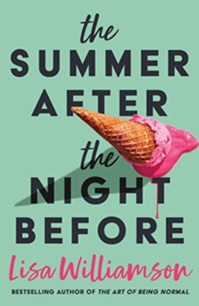
Ben’s been in love with Molly for ever. When she finally kisses him at a party, he thinks all his dreams have come true. And later that night, he thinks they’ve started something really special.
Molly loves Ben too – of course she does. But not like THAT. He’s her best friend’s brother – which makes him practically her brother too, right? But after a few drinks at a party, Molly kisses Ben. And she can’t remember what happened next.
The months of freedom after GCSEs should be the best of your life. But everyone’s reckoning with doubts, lies and mixed-up memories, the thorny summer after the potent night before .
Find on Goodreads. Find on Bookshop.org UK (affiliate link).
About the Author:

Lisa was born and grew up in Nottingham. Following a degree in drama, she worked as an actor for over a decade before writing her debut novel. The Art of Being Normal went on to win the Waterstones Children’s Book Prize for best older fiction.
Lisa is also the author of All About Mia, Paper Avalanche, First Day of My Life, and two titles in the First Names series – Malala and Dwayne. She was also one of seven contributors to the collaborative YA novel Floored. When she’s not writing, Lisa loves long walks, long talks, dessert, good books and bad TV. She lives in London.
Writing consent and communication in THE SUMMER AFTER THE NIGHT BEFORE:
My number one goal as an author is to entertain – anything else is genuinely a bonus. Having said that, if I did want my readers to take away any sort of ‘lesson’ from The Summer After the Night Before, it would be the importance of healthy communication in relationships.
From the very first page, the three narrators (Molly, her best friend Rhiannon and Rhiannon’s twin brother Ben) struggle to express their thoughts and feelings openly with one another, their family and their friends, Before the inciting incident even occurs, tension is already building within the trio, laying the foundation for the confusion, misunderstanding and betrayal that casts a shadow over the days, weeks and months that follow.
Let’s be honest, communication is hard. It takes practice, experience and effort, and you’re not always going to get it right. As a teenager, I found it incredibly hard to express what I wanted (or didn’t want) and consistently shied away from difficult conversations in favour for what I perceived as an easier life. The characters in The Summer After the Night Before are far from perfect. They make mistakes, bottle things up, lash out, tell lies, talk behind one another’s backs and indulge in less-than-generous thoughts. In short, they are human, and as teenagers, navigating many situations for the very first time and with little guidance.
We meet Molly, Rhiannon and Ben on the eve of their GCSE exams. At a house party, Molly drinks too much and is escorted home by Ben. The following morning, she wakes up in Ben’s bed minus her underwear and any solid memory of how she got there. Despite Ben’s claims that nothing happened, Molly is unable to shift the nagging feeling that he knows more than he’s letting on. Feeling unable to confide in Rhiannon or her family, Molly turns to mutual friend Liv, a decision she comes to regret when Liv shares the content of their conversation with her mother. Acutely aware of the possible impact on her relationship with Rhiannon if she voices her suspicions, Molly bottles them up instead, doing her best to convince her friends (and herself), that everything is fine. Ben likewise chooses to bury his head in the sand, channelling his energy into pursuing a relationship with the oblivious Georgie, in the misguided hope that this will somehow right the wrongs of that fateful night. Meanwhile Rhiannon, initially unaware of her friend’s pain and her brother’s guilt, is exploring a brand-new romantic relationship and all of the joy, excitement and terror this brings.
Typically, stories about sexual consent exclude the perpetrator’s point of view (and for good reason). However, from the very beginning of the writing process, I knew that I wanted to present Ben’s point of view alongside Molly and Rhiannon’s. Outwardly sensitive and caring, Ben prides himself on being ‘a good guy’, yet, like many self-proclaimed ‘good guys’, when the chips are high, he prioritizes saving his skin and preserving his reputation over Molly’s wellbeing. When Rhiannon exposes the truth, I shared in her shock and disgust. At the same time, I identified and understood Ben’s panic, fear and confusion.
Although widely taught in schools, consent is a thorny issue. It is easy to agree on the difference between right and wrong in a classroom setting but drunk at a party with a girl you fancy? The perimeters are suddenly a lot less clear. Unaware that Molly is experiencing blackout, Ben can convince himself that although clearly drunk, she is capable of giving consent. When he later realises that this was not the case, instead of being honest, he covers his tracks. In refusing to come clean and give Molly the clarity she so desperately needs, Ben perhaps makes the most catastrophic mistake of all. Unlike Molly and Rhiannon, he is hiding the full truth from the reader, carefully selecting the parts of himself he wishes to reveal. In much the same way, he curates a version of the truth for Molly – one which ultimately fails to stand up to scrutiny. As the story unfolds and Ben’s grip on the narrative begins to slip, we see him at his lowest – weak, desperate, selfish, self-pitying and yet achingly human.
The Summer After the Night Before is by no means a blueprint for healthy communication and nor should it be. In reading Molly, Rhiannon and Ben’s story, readers are given the opportunity to consider what they would do in the same situation. How would they behave? Who would they confide in? Would they make the same mistakes? Fiction can act as a ‘social simulator’, allowing readers to explore how they might navigate difficult real-life situations in a safe, risk-free environment. It’s one of the many reasons why books are so powerful, especially when placed in the hands of teenagers. I would never claim to have all the answers, but it’s my hope that in reading The Summer After the Night Before, young people might feel empowered to come up with their own.
Thank you!
*Affiliate link


Leave a Reply