About the Book:
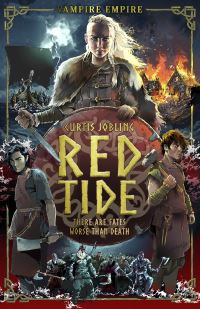
In 900 AD Shetland, a fearless Norse girl and a blacksmith’s son must fight for survival when a supernatural Viking warband descends on their island, bringing terror, blood, and an unquenchable hunger.
The people of Unst, Norse and Pict alike, enjoy lives of relative peace – none more so than Hilde, daughter to Jarl Frida, and Cormac, the blacksmith’s boy. Hilde yearns for a life of adventure, like the one her mother had before her, carving her name in the great sagas as a legendary shieldmaiden.
But Hilde should be careful what she wishes for. When a terrible Viking warband arrive upon the island, shrouded by an otherworldly fog and hellbent upon horror, Hilde and Cormac’s worlds are turned upside down. They bring with them terrors and secrets, the likes of which a Norse girl and a Pictish boy could never have dreamt of in their worst nightmares.
For when the Harrowed Men come raiding, there is no escape from their cruelty – or their hunger. And no amount of blood will slake their thirst …
Find on Goodreads. Find on Bookshop.org UK (affiliate link).
About the Author:

Curtis Jobling is the designer of worldwide hit children’s television show ‘Bob the Builder’, and the author/illustrator of numerous children’s books. He lives with his wife, Emma, in Cheshire, England, along with a menagerie of children and pets.
Although renowned for his work in film & TV, Curtis’s true love has always been horror and fantasy for older audiences. The million-selling ‘Wereworld’ series of novels has been adapted into a major new animated show for NETFLIX, titled Wolf King and produced by Lime Pictures and Jellyfish Pictures.
Interview:
Pitch your book in 10 words!
Historical fantasy horror featuring Vikings, vampires and vengeful gods!
Why did you choose the early 10th century Shetlands as the setting for this book?
It’s right on the edge of the world in many ways – the northernmost tip of the British Isles for starters, and also a distant outlying corner of King Harald Finehair’s kingdom. The Norse people had a strong foothold in that part of the world, whilst the Picts remained a proud and hardy race. Having the two different ethnic groups living side by side in (relative) harmony provided me with tension. And I could dip into ancient Scottish folklore as well as Norse mythology. The best of both worlds for an author to research.
The community Hilde and her fellows grow up in is a blended community of Christian Picts and settled Vikings who believe in the Norse gods. There are tensions between the groups but they are, ultimately, one village. Why was it important for you to explore this aspect of the time period in this way?
I mentioned tension earlier, and tension makes for great drama. The two groups don’t all get along harmoniously, there are all kinds of conflicts there even before the Harrowed Men and Hydyr the Hungry rock up. Integration is a big challenge for any collection of people who come from diverse backgrounds – heck, today is no different. But I do think it’s rather heartening to imagine that folk with different beliefs could find a way to live together way back when.
What was your favourite bit of research you did for this book?
It was specifically the history of Shetland, or the Hjaltlands as they were known back then. There’s not a huge amount of physical evidence remaining of those early Pictish and Norse settlements, but there’s enough for us to draw a picture. Then it was a case of using artistic license to flesh the rest of the world out, such as having a jarlshof on Unst. You have to remember; this is a historical fantasy horror – those last two words are really important…
There are tales of the undead across many cultures. What led you to choose the draugr and strigoi? Where there parts of the mythos you chose to embellish or remove?
I love my tales of undead horror, from The Walking Dead and World War Z through to Salem’s Lot and the Pine Deep stories of Jonathan Maberry. Telling a historical tale featuring such terrors is something I’ve toyed with for years – I love the idea of cursed, undead Vikings who can never enter Valhalla. As for bringing the strigoi – the vampires – into the mix, there’s no evidence of such creatures in Norse mythology, so I dipped into central and eastern European folklore for my inspiration, adding oodles of grotesque horror into the mix for extra flavouring. There’s also a healthy dose of cosmic horror in Vampire Empire as we hint about a God of Vampires, a deity that predates earthly gods of any pantheon. It’s fair to say I’ve always been a big fan of Lovecraft, and the idea of having an Elder God crashing into a world where the Norse and Christian religions have cornered the market in worship was too good to resist.
While Hilde and Cormac are the primary narrators of the tale, two other characters narrate a few chapters – including Hilde’s mother, Frida. Why were you interested in seeing a parent’s perspective, rare as it is in YA?
I simply tell the story I want to read. I love the idea of split narratives and different perspectives in a tale. I’m quite guarded when it comes to Jarl Frida’s tale – I have to be, because like all the characters she has her demons to battle, and I don’t want to reveal too much to the reader from the get-go. I also love the idea of her relationship with Hilde. It’s not perfect, it’s strained, but it’s clear they love each other very much. They just don’t know how to show it.
If you were to start the story in Unst, how well do you think you’d fare?
Oh, I would probably be one of the first people to die when the Harrowed Men come calling. Likely trampled to death or drowning in the latrine pit. Something decidedly unheroic…
Can you give us any hints for the next books?
BLACK HEART, book two of Vampire Empire, will pick up exactly where Red Tide ended. Expect lashing of more cosmic horror, gallons of additional blood and body parts, and a great many more fantastical creatures and races from Norse mythology.
Please recommend a UKYA book you think readers will love.
I can’t really look past THE ENEMY* series by Charlie Higson. My kids love their zombie stories, as do I (I may have mentioned this!), and Charlie’s take on a very British undead apocalypse was a breath of fetid air when I first read it. I passed it on to my children who in turn devoured the series like horror-hungry revenants.
Thank you, Curtis!
*Affiliate link


Leave a Reply