About the Book:
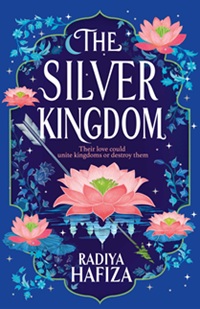
Sparks fly when Prince Zayd, fresh from defending the borders of Dakaria meets Princess Layla of Sawan, determined to run away from her cruel, power-hungry mother.
When Layla discovers she has latent powers, ones she doesn’t understand and begins to fear, and Zayd begins to negotiate with the mages, who have been in hiding for a hundred years, the young royals’ paths become intertwined.
But the kingdoms are divided, still suffering from the fallout of colonial rule, and both the prince and the princess must marry to build alliances, not for love. As Layla and Zayd struggle between their hearts and their duties, a centuries-old prophecy is set into motion, calling upon a saviour to restore the mages to their true power.
Could Layla be the key to finally uniting their kingdoms, or will forbidden love plunge the lands into a devasting war?
Find on Goodreads. Find on Bookshop.org UK (affiliate link).
About the Author:
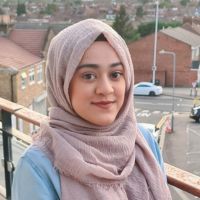
Radiya Hafiza is the author of Rumaysa: A Fairytale, Rumaysa: Ever After and Aya and the Star Chaser. Radiya enjoys making up worlds where anything can happen and nothing is quite as it seems. She grew up in Hackney and now lives in Essex with her family.
Interview:
Pitch your book in 10 words!
A swoony South Asian inspired romantasy that re-imagines the partition of India.
Both Zayd and Layla are betrothed to foreign royals for political reasons although neither particularly wants to be married – including Layla’s megalomaniac mother engaging her to the prince of their former oppressor state. What drew you to explore arranged marriages in politics?
Arranged marriages are a big part of royal alliances historically as well as in South Asian culture. It was fun to explore this topic in a high-stakes situation, where kingdoms and security quite literally depend on marrying advantageously. But what happens when you’re meant to marry for duty, but your heart belongs to someone else? What does it do to a country when the people are against a union? It was so interesting seeing how both Zayd and Layla responded to their situations and how far they were both willing to go in order to be true to themselves. In their world, these arranged marriages are unquestionable, and they both have a lot of responsibility on their shoulders. But as a hopeless romantic, I think it makes it all the more rewarding when two people choose each other against everything else that they know.
Zayd and Layla’s relationship is forbidden and a deliciously slow burning one. What is the key to getting the chemistry and tense yearning just right?
I think a big part of building tension and chemistry is stopping the characters just before something could happen. There were so many moments that Layla and Zayd could have given into their feelings, but it makes it all the more tense when they don’t, leaving them and the readers with that question of what if? It’s also important to give the characters something more than just physical attraction to base their feelings off. Zayd and Layla find solidarity in one another, a companionship where they can actually be honest with each other, instead of having to play appearances for everyone else. It makes it all the more painful that they can’t be together when they work together so well!
Layla’s mother is the Sultana Regent – and is the sort of character you want to reach through the page and shake when she treats her daughter like dirt. Zayd’s mother, by contrast, is supportive and loving of her children – but is firm when necessary. Why did you want to create such contrasting mothers for the two heirs?
It’s really important to have healthy people and relationships represented in literature and media. This book is aimed at young people, so I wanted to make sure I was showing good behaviours alongside more complex ones so we can make a clear distinction from right and wrong. The two mothers are very different in nature, Zahra is abusive and Aysha is loving which has shaped both of their children. Zayd is deeply loyal and caring, while Layla is the opposite of her mother – compassionate and understanding because of the pain she’s gone through. Part of me also wanted to give Layla a glimpse of what a normal mother-daughter relationship should look like as it’s something she’s never experienced.
Luckily, the two leads aren’t alone with just their parents for support (or lack thereof!) Layla has her close friend and maidservant Mira, while Zayd has his brother Yunus (who can be vexing, as any sibling is!) and the head of his guards, Noor. Were these always the people you placed around them? Did their relationships with the leads change across edits?
For Layla, I always knew Mira would be her best friend and a deep comfort for her in the palace. It was important that she had someone she could feel safe with as she experiences a lot of abuse at the hands of her mother. Oftentimes, it’s the people around us that help us get through dark days, whether they realise it or not.
I didn’t set out for Yunus and Noor to be such important people in the book but when I started writing them, Yunus just jumped off the page and his personality shone. He became one of my favourite characters to write, as well as Noor who is a bit like a big brother. Zayd is always worrying about everyone else and so it was important, I felt, to surround him with people who put him first too.
Whenever I write a book, I always have a rough plan on how I want the story to go. But once I start writing, the characters take on a life of their own and take me on their own journey and show me their life, rather than me making up their story.
As well as spending the book across the kingdoms of Dakaria and Sawan, your world extends to countries such as Valthar and Fallowmere, which feel very richly drawn despite not appearing on page. What sources of inspiration did you draw on when creating the world?
This world is loosely inspired by the partition of India and in particular the Bangladesh Liberation War of 1971 from Pakistan. I was inspired to create this world by my father’s experiences of surviving the war waged by Pakistan on Bangladesh, as well as the racism and colourism Bengalis often experience within the South Asian community. Fantasy gave me a way to explore these topics and British colonialism with some distance, so it didn’t feel so personal and was therefore easier to write. It can be quite a heavy space to occupy, writing about the effects of colonialism and racism, especially when it still persists today under the guise of western liberation. Ultimately, real world events and experiences have shaped THE SILVER KINGDOM which fed into the politics of the book.
If you had to choose one country to live in for at least a year, which would it be?
I’d go to Dakaria for a year! I would love to see The Silver Kingdom world in the flesh – visit the Silver Port, sail down the endless waterways, explore the beautiful palace grounds and night markets.
The magic of the three kingdoms has all but been wiped out by the brutal colonial oppression of Fallowmere. If you were one of the surviving mages, which element would you want to weld and why?
I’d want to be an earth mage! The powers they have are incredible – healing tears, the ability to command nature – which we’ll be seeing more of in the sequel to THE SILVER KINGDOM!
Please recommend a UKYA book you think readers will love.
HEAVENSENT AND HELLBENT* by Sara Jafari – this is such a fun read and reminiscent of the Twilight era where contemporary fiction x fantasy collide together! I really enjoyed this book and its unique spin on Persian mythology.
Thank you!
*Affiliate link
 #UKYASpotlight
Leave a comment