About the Book:
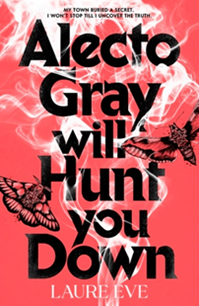
When a boy in her town starts claiming that a demon is stalking him – Alecto Gray has no choice but to investigate. After all, that’s exactly what her brother Lucas said, right before he died…
Soon, Alecto’s investigation leads her to a far-reaching conspiracy – with two warring factions at its heart – as she uncovers a sinister underbelly to her small seaside town.
Armed only with her razor-sharp wit and a talent for getting into trouble, Alec endures threats and kidnappings, and even the spark of a new romance, in order to get to the truth.
But can she handle the truth or will the twisted darkness at the heart of the mystery destroy her as well?
Find on Goodreads. Find on Bookshop.org UK (affiliate link).
About the Author:

Laure Eve is a novelist and screenwriter. She is the author of critically acclaimed YA duologies The Graces and The Curses, Fearsome Dreamer and The Illusionists and is also a screenwriter and producer on several film and tv projects.
Interview:
Pitch your book in 10 words!
It’s Veronica Mars with demonic flavouring.
Alec adores Mystery Noir and it informs her whole investigation. How did the tropes of that genre play into how you developed the story?
A favourite writing trick of mine is to introduce familiar plot types and then try to subvert or upend them. I like writing people who appear to inhabit a familiar character archetype and end up being something a little more unexpected. Alec leans into this herself — she uses beloved movie tropes to make sense of unfolding situations. She thinks she’s doing it in a knowing way — in the book, she tells another character that if this were a noir, they’d definitely be the femme fatale (and I can’t say anything more about how that plays out without giant spoilers). But even being aware of this she still falls into noir tropes, only to be surprised when things and people turn out messier, more complex and less definable than that.
All that to say — I wanted the story to play out very much like a classic noir, but with a few surprises along the way.
Alec has such a distinct narrative voice. How did you work on developing that?
I seem categorically unable to write stories that deal with lighter, more everyday experiences — there’s always something in me that wants to go for the throat. I’m perennially curious about extreme experience, and fiction is a safe outlet to explore dark situations you don’t actually ever want to go through in real life.
But I have to say, I’m bored of dark characters. I’ve written some real intense emo types, and while that can be cathartic, it turns out they aren’t that much fun to be around. You really wouldn’t want a morose sociopath as a dinner guest, you know? They’re actually quite dull. And you have to spend an awful lot of time with the main character of a novel, whether as a writer or a reader.
I’m not the kind of writer that can make murder, suicide and deep-rooted misogyny funny, but I can make the voice that explores them a damn good time. An Alec quote that says it best: ‘I am coriander. Many people are genetically predisposed to disliking my taste.’ She is a real particular taste, and therefore not for everyone. But I like coriander.
The tension between the supernatural and mental health is so well done, leaving the reader unsure if there is a supernatural element or whether it’s something far more mundane like drugs interacting with a guilty conscience. How much of a challenge was it to maintain that balance?
I really enjoy stories that refuse to pull back the curtain at the end. Conversely I tend not to enjoy didactic stories that keep telling me very clearly what I’m supposed to think. This device of it could be this or it could be that — especially when it’s a question of ‘but is it supernatural or not?’ — is a tricky one to pull off.
Sometimes a definitive answer is the goal all along — without giving too much away, another book of mine, THE GRACES, was written entirely around pointing to the end reveal. The difficulty with that kind of story is the care with which you have to sprinkle misdirection along the way, so no-one twigs too early and the answer lands hard when it comes, like a great magic trick.
But in other kinds of story, like ALECTO, the ‘is it this or is it that’ device functions as a mirror to the real world, where we live with no objective truth. Some people will always think the funny light in the sky is aliens, and some people will always think it’s a weather balloon. Prove it’s an alien — or a demon — definitively, to everyone, as incontrovertible fact. Prove it’s a weather balloon — or mental illness — definitively, to everyone, as incontrovertible fact. Try it, go on — see how far you get. That’s not how the world works. That’s not how people work. Sometimes, the uncertainty is the whole point of the story.
Anyway, I hope I pulled it off!
Alec’s relationship with the priest, Oh, is a crucial one. He’s someone she can talk to, confide in – but not in a confessional way as her own faith isn’t certain. Why did you choose to have a priest as her friend and confidant?
I don’t think it’s fair to have a plot that revolves around Catholic belief systems but without any Catholic priests as important characters. Oh is actually a little bit based on a man from my childhood that I was too young to remember, but that my parents both still think of very fondly. His name was Father Dennis, he was an Irish Catholic priest at their local church, and despite being a lot older, he was a friend to them both. Their stories of him were full of warmth. That my father was and still is basically an atheist apparently wasn’t a barrier to their connection.
Oh loves Oreos. What’s your favourite flavour?
Do you know, I don’t eat them.
You drew from the Erinyes Greek Mythology for The Kindly Ones who really resonate in the current climate. Why did you choose to include them in this story?
I find that writers tend to have certain obsessions, thematic concerns if you will, that crop up again and again in their writing – a lifelong question they keep trying to answer. My “thematic concern” is around vengeance. When is it justice, when is it vigilantism, where is the line and why does it shift depending on perspective and circumstance? Sometimes murder feels really freaking justified, doesn’t it? And isn’t that really scary and interesting?
I think there’s been a lot of vengeance going around in society lately, and I think the question of whether it’s “justified” not only depends on who is answering the question, but when they’re answering it.
And isn’t that really scary and interesting?
Please recommend a UKYA book you think readers will love.
THE OWL SERVICE*, by Alan Garner. It was published a long time before we came up with the YA label, but it absolutely is. I mean, it features a teenage love triangle. It’s a beautifully sparse rendering of legend come to life in a realistic, contemporary setting. And Alan Garner is one of the best, most magical, most haunting writers the British Isles has ever produced, full stop.
Thank you, Laure!
*Affiliate link
 #UKYASpotlight
Leave a comment