
About the Book:
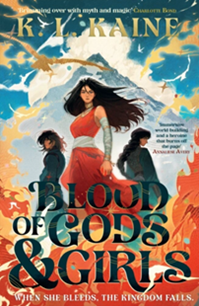
When she bleeds, the Kingdom falls.
At five years old, Nisha was selected to be the Mortal Goddess – a vessel for the great Goddess Shantavi. But on her twelfth birthday, Nisha escaped the temple before she could be sacrificed at the hands of the Immortal King.
Now the Kingdom searches for its new Mortal Goddess and their eye has fallen on Ratna, the only family Nisha has left.
Helped by a Golden Eagle Warrior and the only boy she has ever trusted, Nisha must learn to embrace her power in order to liberate her people.
It’s time to take the Kingdom back.
Find on Goodreads. Find on Bookshop.org UK (affiliate link).
About the Author:

Katja Kaine is a Yorkshire-based writer of fantasy novels. She is also the creator of the Novel Factory software for writers and the Novel Writing Roadmap. She has won multiple awards for writing, including the Northern Writers Northern Promise Award, the SCBWI Undiscovered Voices competition and been shortlisted for the Bath Children’s Award and the Write Mentor Novel-In Development Award. Katja is half Singaporean and half German and when she’s not writing can be found cooing over forest fungi, bending into pretzel yoga shapes and raging against the patriarchy.
Interview:
Pitch your book in 10 words!
Fantasy adventure with Goddesses, flying lionesses, love, betrayal and secrets…
Nisha is forced to become the physical embodiment of the Goddess on earth aged five, which leads to plenty of trauma that she is literally running from. How did her character come to you?
I always knew that I wanted her to feel powerless at the beginning, and to slowly realise the power that lay within her. I knew that she had that spark right from the beginning, so I had to find ways to get that across in a way that felt natural.
In YA it’s common for the heroes to be quite sassy and witty, and have clever retorts. I knew that Nisha wouldn’t have the confidence to speak out in that way, but I didn’t want her to come across as too meek either, so I wanted to show that she has that sassiness and wit right from the beginning, but she keeps it suppressed and self-censors what she says out loud.
This is how I wanted to do it, because I wrote this story for all the girls who do that – who feel like they can’t speak up and that they don’t deserve space and a voice. I wanted to see themselves in Nisha and then go on a journey of self-discovery with her, and hopefully come out the other end with a bit more confidence in their own ‘roar’.
What inspirations did you draw on when building the enclave and Khas Kura?
Most things in the novel are drawn from my own experiences – travelling the world, in particular Asia, and also some of the research I’ve done into the history of women’s rights, important figures in history (many who have been erased, or had their stories distorted by male historians) and philosophy.
The enclave in particular was partially inspired by hearing about the Umoja village in Kenya, where women have set up an all female matriarchy as a sanctuary for young women fleeing violence. Khas Kura is a blend of landscapes mostly in Asia, including the Himalayas, Petra in Jordan, The Zhang Jia Jie mountains in China, and places I’ve visited in Singapore and Malaysia.
Nisha, Garuda, and Devance travel all over Khas Kura in the story. What was your favourite location to write about?
A few years ago I was fortunate enough to visit the Himalayas, and it was striking how emotional you feel when you see those vast mountains. I wanted to get that across in the story, so I enjoyed describing that landscape, and showing how many different faces and personalities snow has!
I also really enjoyed writing about Ghati City – the city dug into the sides of a dusty red canyon. There’s just something about the idea which really appeals to me, and I liked exploring how the different classes in society might create their homes in different ways from the same material, from the people with very simple houses, all the way up to the most elaborate.
There are some brilliant animal companions in the book including Golden Hawks (check) and Sinha (Flying lionesses!) What magical animal companion would you like to have?
If I could have any magical animal companion, I think it would probably be a tiger version of the Sinha – a giant flying tiger.
Who wouldn’t want to be able to fly on the back of one of those, and having a creature that big on your side would certainly stop anyone from messing with you!
The magic system is based around the goddess, Shantavi but female spellcasters are banned from practising upon pain of death, even though they’re more effective than the males. Where did you draw inspiration for the magic system from?
The magic system is very heavily inspired by my sense of connectivity in the universe, and nature. All the powers come from tapping into the deeper oneness, and in doing so, it’s possible to heal, come to terms with death, and find deep strength and power inside.
Shantavi’s tributes always represent food, water and comfort, which I chose to represent the things we really need – not gold or anything fancy or wealth based, but remembering our basic human needs.
The women being banned from practicing is sadly based on real women’s experience of such things over the 5,000 years or so of patriarchy we’ve endured. There’s more and more evidence emerging every year that in prehistoric times women were respected shamans, holy women and healers. But patriarchal forces pushed women out of medicine and religion.
I think that modern medicine is starting to realise that to effectively treat people’s ailments, you really need to take the whole person into account, which hasn’t really happened in western medicine. I think this is something that women-led healing took into account in the past.
Nisha’s world isn’t so very different from our own, reflecting the misogyny inherent in many of our societal structures – and the behaviours it permits. Why did you choose now to write the story?
I remember as a girl thinking that there had obviously been disadvantages for women in the past, but we pretty much had equality now, didn’t we?
Then I’m afraid to say the more I learned and the closer I looked, the more I realised how tight and suffocating the patriarchy’s grip still is on girls and women, and how limited we are: by laws, by culture and by the messages and narratives we get from the moment our nurseries are painted pink.
What frustrates me the most is how so many girls still think that when they don’t achieve things, it’s their personal failure, and don’t realise how so many things are stacked against them, so they have to work twice as hard just to receive half as much recognition as their male peers.
I literally lie awake at night being frustrated about this, and I believe that stories are both a reflection of the world, and a way for us to change our beliefs, so writing a novel about the thing that was firing me up was probably inevitable.
If there are girls who are reading this who suspect I’m exaggerating, then I would highly recommend reading INVISIBLE WOMEN* by Caroline Criado Perez – it was revelatory to me, showing with impeccable research, how the world is designed for men, and how that makes almost every aspect of life just a little bit (or a lot) harder for women, which has a devastating cumulative effect.
Garuda is a sky witch or Khonejharu, a group of people who have hidden themselves due to persecution led by The Immortal King. Their culture of matriarchy provides a counterpoint to The Immortal King’s regime. Do you think their vision for a matriarchal instead of patriarchal society is possible in our western societies?
I think that it’s imperative that we move away from a patriarchal style system if humanity is going to survive.
The current system is built on unlimited growth, accumulation of wealth, and the pillaging of the earth’s resources by whoever is willing and able to be the most brutish and bullying about it. It’s fairly clear at this point that continuing with those principles guiding us will lead to our destruction, and we’ll take a lot of the beautiful complexity of life with us.
Matriarchy isn’t just the same system but with a woman at the top of the ladder. In contrast, matriarchal societies are built on the communal good, sharing resources, and sustainability. Many people think that’s idealistic and unrealistic, but that’s just because of the effectiveness of patriarchal propaganda. Before certain men went around imposing their systems on everybody else by force, there were numerous egalitarian societies where women were equal to men, children were not beaten to ‘discipline’ them, and people measured their wealth with what they could give and how happy they were, not by how many mega yachts they could buy.
If we are going to move to a society with different values (and therefore survive as a species), the first thing we need to do is reject the patriarchal propaganda that anything other than the system that benefits the rich and powerful is not realistic, or not natural. There is nothing natural or inevitable about the patriarchy, and it takes an awful lot of effort, unfair laws, unpaid labour and propaganda to maintain it.
Please recommend a UKYA book you think readers will love.
ROAR* by Manjeet Mann – I adored this poetic novel about a girl in India who falls victim to discrimination based on her gender and goes on a gripping adventure filled with danger and discovery. It’s incredibly moving, heartbreaking and hopeful.
Thank you, Katja!
(We interviewed Manjeet Mann about ROAR – you can read our interview here)
*Affiliate link


Leave a Reply