
About the Book:
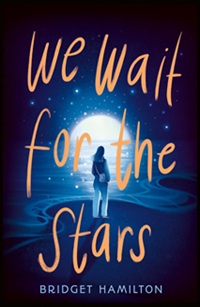
When clouds roll in, wool-thick and grey,
and it’s harder to breathe than before,
when we can’t remember Dad’s face
or how he sounded anymore,
we wait for the stars.
After losing her dad, Celeste’s life feels like it’s splintering. Then she makes a new friend in Katie, who shares her love of the beach, and meets Reuben, a fellow photographer. Maybe a new friendship group is just what she needs – as long as she keeps her growing attraction to Reuben out of the equation. But Celeste soon finds that emotions can’t be bottled up…
Find on Goodreads. Find on Bookshop.org UK (affiliate link).
About the Author:
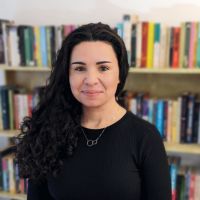
Bridget Hamilton (she/her) is a writer, podcaster, and creative practitioner. Originally from Kent, she headed to the North East of England for university, fell in love with the region and forgot to leave! She now lives in Newcastle upon Tyne with her family and their cat, Scout. Bridget believes that everyone should have the opportunity to read and write stories. Her job sees her travel to schools, youth groups, community centres and even inside prisons to teach creative writing. Meanwhile, her own writing centres around home, family and identity. She has created work for organisations such as the Hexham Book Festival, Kielder Observatory, Poet in the City and BBC Radio Three.
Interview:
Pitch your book in 10 words.
A poignant verse novel on grief, set beside the sea!
WE WAIT FOR THE STARS is a novel in verse. What drew you to verse over prose for Celeste’s story?
I had been reading a lot of brilliant verse novels when I first had the idea for WE WAITR FOR THE STARS and I think the themes of the book really lend themselves to verse – the push and pull of the waves, the rhythmic nature of the seasons and how non-linear the grieving process can be. I have previously written and performed lots of poetry so as soon as it occurred to me to write it in verse it just made sense! I loved being able to play around with how the words looked on the page and also did a lot of reading aloud when I was editing.
The story begins with the sudden and unexpected death of Celeste’s father, this is very much the catalyst for the complex and delicate family dynamic in the book. What made you want to explore the impact of grief not just on the individual but the family unit?
While Celeste’s grief is the most central to the story, I wanted to reflect the fact that everybody grieves differently – even if they are grieving the same person, because they will all have had a different relationship with them.
Rae is the antithesis to Celeste’s grief – they are angry and impolite about it and don’t care if it inconveniences people. Meanwhile mum Mona is throwing herself into new art projects when Celeste seems to think she should still be sitting around moping. No way is portrayed as wrong or right, but it definitely makes for some tension in the house more on more than one occasion…
Celeste has a precious rock collection that is intrinsically tied to memories of her father. What seemingly random item(s) do you have that embody precious memories?
Oh gosh, I have so many! I have lots of books and vinyl records that I associate with my dad. I can remember certain albums he lent me or books that we read in tandem so we could discuss them afterwards. He also bought me books for birthdays or Christmas and signed them with the date, so those ones are particularly special.
Family members on both sides of my family have entrusted me with letters, photo albums and other pieces of family history which I absolutely treasure. And of course, I have my own personal collection of sea glass and rocks, including an ammonite I found on Whitby beach which is supposedly 180 million years old! I don’t remember the story behind every single stone, but they remind me to go out walking if I need to clear my head – to focus on what’s under my feet rather than getting too overwhelmed with the big things.
Celeste’s grief colours and places blinkers not just on her family life but her friendships as well. She ends up not just grieving her dad but the loss of her best friendships even as she forges new friends as she begins sixth form. What would you like readers to take away from Celeste’s experience?
Celeste’s friends are trying their best to understand what she’s going through, but often miss the mark. At the same time, Celeste doesn’t always know what she actually wants from them or how they could make her feel better. I remember this from my own grief experience; you feel like you’re ruining people’s fun if you get upset or don’t seem in a great mood, and sometimes they don’t include you in things because they don’t know what to say around you. I hope readers come to empathise with both sides; grief is a tricky thing to navigate, and adults often don’t get it right, either. By the end of the novel everyone has started to give each other a little more grace which I think is really important.
Celeste’s new best friend Katie is an incredibly complex character who tries to hide the burdens and tolls of her own mental health struggles and being a young carer for her mum whilst trying to balance her studies and community projects with limited success. What drew you to write about a young carer?
I was a young carer for my mum who was diagnosed with MS when I was about 8 years old. While I didn’t have to care for her alone like Katie does, I know how it feels to have that weight of responsibility on your shoulders and for it to have become so normal in your life that you don’t necessarily reach out to anyone for support. I wanted to create a character that young carers would resonate with, but I also think Katie is a broader reminder to all of us that we never really know what’s going on in a person’s life. Even people who seem to have it all figured out – or even someone helping us with our problems – might be struggling with something themselves.
Katie brings Celeste out of her shell and engages her in several community projects such as the beach clean. What hobbies/community activities bring you joy and get you out of the house?
I love going on walks with my husband and little boy – we are lucky to have a beautiful beach about 10 minutes from our house and lots of country parks, forests, and river walks. I also enjoy a dip in the North Sea with my writer friends from time to time – even though it’s always freezing!
When I first lost my dad, I got involved with a charity called Let’s Talk about Loss which organises meet ups across the UK for 18–35-year-olds who have been bereaved. I found that to be a massive support. Our group did everything from pub trips and museum visits to Christmas crafts and summer picnics. Having friends who understood what you were going through was really helpful, and even though I’m often too busy with my job and my toddler to go to meet ups nowadays, I still keep in touch with a few of the lovely people I met.
Please recommend a UKYA book you think readers will love.
THE BLACK FLAMINGO* by Dean Atta – it’s a bold, unapologetic novel in verse which encourages you to embrace your whole self. It has brilliant mixed race and LGBTQIA+ representation.
Thank you, Bridget!
*Affiliate link
 #UKYASpotlight
Leave a comment