About the Book:
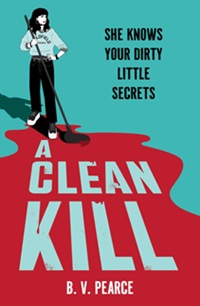
Dirty little secrets need cleaning up . . .
Brilliant aspiring scientist Sabrina has won a scholarship to study chemistry at a prestigious London university. Best of all, it includes accommodation in the Infaustus Apartments, where the university’s richest students are housed in luxury. But life in London is expensive, so Sabrina takes a job cleaning the residence.
Invisible in her cleaner’s uniform, Sabrina discovers all her classmates’ dirty little secrets. It’s impossible to forget that she is an outsider, but luckily, Sabrina has never been afraid of hard work, and she’s determined to make a better life for herself.
However, Sabrina’s life soon gets very messy when she discovers the dead body of rugby star, Chase Matthews. All the residents are suspects, and Sabrina knows better than most that everyone has a motive to want Chase dead.
Trying to keep investigations away from her own past, Sabrina must use all her smarts to expose the killer before she ends up as their next victim.
Find on Goodreads. Find on Bookshop.org UK (affiliate link).
About the Author:

Bryony Pearce is a multi-award-winning novelist working in the Children’s, YA and Adult markets. In the YA genre she has produced a mixture of dark thrillers, paranormal adventures, dystopia and horror. She also writes adult thrillers.
Bryony teaches the course Writing for Children at City University, works as a consultant and mentor to other writers and regularly visits schools to speak about reading and writing. She conducts creative writing workshops, as well as delivering entertaining and inspirational talks and has performed at the Edinburgh Literary Festival, The Wychwood Festival, Comicon, YALC, the Sci Fi Weekender, The Just So Festival and a number of other festivals and events.
The Impact of Wealth on Education:
In the UK, wealthy families can pay for private education, tutoring and extracurriculars for their children, to raise their chances of good exam results. They can also afford to contribute to, or cover, the cost of attending university, something which may leave less advantaged students in terrifying debt, and put many of them off the whole idea.
The advantage of wealth does not only lie in private schooling. The most disadvantaged students face a lack of basics such as stationary, books, technology or dedicated study spaces. They may be trying to study while they are hungry, cold or caring for others.
Schools in wealthier catchment areas also tend to have better parent involvement and fund-raising, which ensures better resources for students.
Don’t get me wrong – there are many bright and hard-working students from less well-off backgrounds who go to Russell Group universities. But not enough.
In the nineties, I was one of those students.
My parents were pretty middle-class. I’m not claiming poverty that I didn’t experience; I was a Forces child. Still, my mother bought my clothes from a thrift shop, I was waitressing as soon as I was old enough to work, and I attended the local state comprehensive. The only extracurricular I was allowed was Air Cadets (which was held on base), and I was the first person in my family to apply to university. If I was filling in a UCAS form in 2026, I’d be eligible for contextual offers.
To my surprise I got an offer from, and eventually the grades for, Cambridge University, and found myself in a bastion of education and privilege which allowed me an insight into ‘the way the other half live’, as Mum called it.
Many thought of me as a ‘DEI hire’ (in those days that was called – ‘you only got in because you’re a girl and the college needed some state school students’). Still, my room felt huge, we got high-quality meals and an education that often included one-on-one supervisions with professors who were top in their fields.
Honestly, I lived the fairytale of the girl in the second-hand skirt and charity shop jacket, who got a room in a beautiful tower above the Parker Library and read books until her eyes blurred.
However, I also had to wear a gown to ‘hall’, mumble my way through Latin prayers I couldn’t understand, and take part in confusing rituals involving drinking from horns, or taking snuff. I was told by my Director of Studies that my vocabulary was far too small (several humiliating experiences involved words I’d seen written down, but never heard spoken), and I didn’t understand all the social rules that appeared to govern the students surrounding me, many of whom had often been to single-sex boarding schools.
During my finals I had to do an English exam on Chaucer which, to my shock, involved translating two pages of Latin. Try telling me that didn’t give an unfair advantage to the public school students …
But I digress. I wanted to tell you an anecdote. All the colleges in Cambridge had (and I assume still have) male and female drinking societies, which went to social events with those from other colleges. On one particular night the Corpus Christi female drinking society (with me along to make up numbers) went out with the lads from Magdelene.
In those days Magdelene was over 90% public school and these boys still wore black arm bands to grieve the day women were permitted into their college. On that night out, our group was told by these public school boys that ‘women shouldn’t be allowed into higher education’, and that ‘boys who went to Eton or Harrow should get automatic free places at Oxbridge, as their parents had paid so much for their education already’. Then I was groped by two lads simultaneously, who seemed to think I owed them something, because I was had been out drinking with them.
These boys, or similar, possibly less bruised, ones, are likely now in positions of power in this country and the fact is that nowadays things are better, but not so much better that children from privileged families, like those boys, don’t still have a huge leg-up.
Let’s get some numbers into play. Public school students make up 25-30% of UK domiciled undergraduates in Russell Group Universities. This sounds pretty good, until you realise that Public schools make up only six percent of the students in the UK. This means that public school students are hugely over-represented in the Russell Group.
In post-1992 and regional universities the figures are much more representative, with state school representation around 90-95% of the student body.
There are reasons for this that seem obvious. Post 1992 and regional universities are less selective, and students from less affluent areas are more likely to stay nearer to home so they can save accommodation costs. Some top-tier state school students are very sadly simply put off applying to Russell Group universities due to their reputation as being ‘full of public school students’. If these students don’t apply, the Russel Group universities can’t accept their applications. Furthermore, many state schools simply do not have the ability to support students through a selective entrance process.
Three years ago my own daughter got an interview at Oxford. Her school gave her zero support, no interview practice, no exercises to help with the ‘test portion’, and then organised her EPQ presentation on the same day as four Oxford interviews. On that day she was up against public school students with huge amounts of support from their teachers, who had been preparing for the interviews since they started sixth form (if not before)!
I’m not saying that there are not support initiatives for children from disadvantaged backgrounds. There are free-school meals, there are contextual offers, there are some great programs from Russell Group universities to get state school students to apply. Still, state school students remain up against a ‘machine’ of public schools designed to funnel the most advantaged kids into high-performing, highly selective universities.
This is a topic that could take me thousands of words to cover in detail, but the fact is, wealth means privilege that starts early and that, while there are initiatives to address the imbalance, it is not even close to being a fair system.
This imbalance is one of the issues that I wanted to cover in A Clean Kill, where my protagonist, Sabrina, a Chemistry genius from a low-income family in Blackburn, gets into a fictional university, Goldfield (a London equivalent of Oxbridge). Due to incredible entrance exam results she also gets assigned to a ‘top-tier students only’ accommodation called Infaustus, where she swiftly realises that at least some of the other students have essentially bought their way in (see ‘a Faustian deal’!).
She becomes a cleaner to help her pay for university, and almost instantly loses what little respect they had for her. When one of her shifts ends with the discovery of murdered student playboy Chase Matthews, she is arrested and, as she says, the police aren’t going to be looking at the other students on her floor:
‘Check your privilege … Who do you think they’re going to pin it on? The oil baron’s daughter? … The influencer with the daddy in government? … The Varsity sports star? … A tech genius whose parents own half of Sweden?’
So Sabrina has to prove that someone else killed Chase Matthews, before she gets charged for the crime.
As I said, for me going to Cambridge in the nineties was a fairytale, which included a few monsters I needed to vanquish, a handsome Prince (not actually a Prince but, reader, I married him) and way more positives than negatives.
A Clean Kill is a fairytale too. It’s a Cinderella story, where Sabrina almost takes too long to work out who the Prince is, and which roles the other students play in her narrative.
It is also a novel about wealth and privilege, and how the wealthy have opportunities that others do not, where lessons about the importance of real work are hard-learned and where all that glitters is not gold.
I hope you enjoy reading A Clean Kill and enjoy meeting Sabrina. I also hope you enjoy reading about Goldfield and Infaustus – have fun trying to work out ‘whodunnit’.
Love from Bryony
Thank you, Bryony!
 #UKYASpotlight
Leave a comment