About the Book:
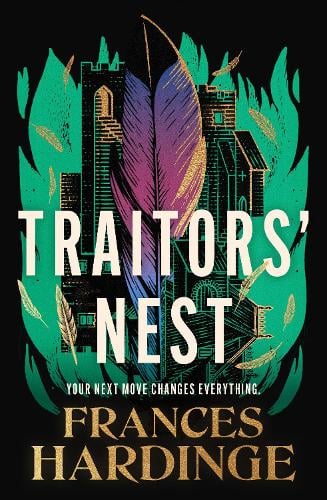
Castles traded places sometimes. Everyone knew that. It was always something that might happen, except that it never had. It was one of those unlikelihoods, like finding treasure, or being eaten by a wolf, or having a handsome, powerful stranger turn up to right all your wrongs. It could happen, except it didn’t.
Until all of a sudden it did.
Far above the valleys and villages of the Kingdom of Thaletal, a Great Game is played. Players move castles around the realm like chess pieces – and the ordinary villagers are mere pawns at the whim of their tactics.
When 16-year-old Burr’s peaceful village is disrupted by the arrival of an ominous new castle, he decides he’s had enough. But what starts as a plucky coup soon escalates – and soon the castle is wrenched away to a far-flung corner of the kingdom, where whispers mount of a mysterious ancient maiden whose magpies collect her debts at dangerous prices.
Here, the stakes are higher than the tallest turrets, and every move counts. Burr must work with his sisters and friends – and rely on the unexpected help of a strange and intriguing heiress – to unravel the secrets of the Magpie Maiden and the origins of the Great Game before he becomes just another casualty of the Players’ deadly contest.
Find on Goodreads. Find on Bookshop.org UK (affiliate link).
About the Author:
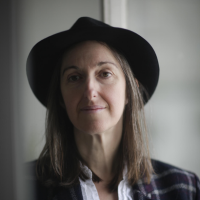
Frances Hardinge spent a large part of her childhood in a huge old house that inspired her to write strange stories from an early age. She read English at Oxford University, then got a job at a software company. However, a few years later a persistent friend finally managed to bully Frances into sending a few chapters of Fly By Night, her first children’s novel, to a publisher. Macmillan made her an immediate offer. The book went on to publish to huge critical acclaim and win the Branford Boase First Novel Award. She has since written many highly acclaimed children’s novels including, Fly By Night’s sequel, Twilight Robbery, as well as the Carnegie shortlisted Cuckoo Song and the Costa Book of the Year winner, The Lie Tree.
Interview:
Pitch your book in 10 words!
Medieval-flavoured adventure where castles teleport, magpies scheme, rebellion simmers…
The central premise of the book involves castles that suddenly teleport to another part of the world, moved by Players in a strange, inaccessible Game. What inspired this book’s novel concept?
I came up with the central idea of Traitors’ Nest when I was on holiday in French Catalonia with two friends. We had been visiting quite a few wonderful castles on both sides of the French-Spanish border, some of which had changed hands several times, because different forces were battling to control the region. If you want to dominate an area, it really helps if you control the local castle.
While we were being shown around one particular castle, and were being shown its defences, its battle damage, the changes made by different occupants, I found myself wondering what it would have been like if you were an ordinary person living nearby. One day a new army marches in and captures the local castle. Suddenly you and all your friends and neighbours are under the rule of somebody you know nothing about. How frightening would that be?
Then I wondered, what if the change was even more sudden and dramatic? What if you woke up one morning and discovered an entirely new castle standing in the place of the old one?
Perhaps the inhabitants of the castle would be just as surprised and aghast. Then who was responsible for switching the castles around? I started to imagine an other-worldly hall where indistinct, all-powerful figures pored over a vast game board shaped like a map, where all the playing pieces were castles…
Like your previous books, this is very much in the teen side of YA, suitable for all teenagers. What draws you to write for this underserved section of the YA market?
To be completely honest, when I sit down to write I’m not thinking about a ‘market’. I tell the stories that call to me, and write them in the way they want to be written. Some of my books feel a bit ‘older’ than others, but that’s just how it seems to have worked out. My imagined reader is a younger version of me, but the real readers who like the weird stories that I produce seem to vary widely in terms of age, and I’m pretty happy about that.
Burr is the main character of the book but we do see bits and pieces from other perspectives – particularly as the story’s scope grows. Did you always have the other characters’ scenes in your original concept or was that something that evolved with the book?
This varies from book to book. In the case of Unraveller*, I knew from the start that I would have two main characters, and that for most of the book I would be dividing the POV between them. My other books set in alternative worlds are mostly seen through the eyes of the protagonist, but with occasional brief detours into other characters’ heads, particularly when a lot of things are happening at the same time in different places. On the other hand, my historical fantasies (Cuckoo Song, The Lie Tree and A Skinful of Shadows) are almost entirely single POV, as is my only book with a contemporary setting (Verdigris Deep).
I didn’t exactly plan it that way, though! I generally go with what feels right for the story. Even at an early stage, I may get a sense that I can round out a particular story more effectively by allowing occasional glimpses of other perspectives. Other stories work better if the reader is locked in the protagonist’s head, only knowing what they do, piecing things together from the same clues, struggling with the same preconceptions.
The book is set in another world that draws inspiration from our history – in particular, it feels reminiscent of the Anarchy (1138-1153) in terms of the important role castles play in that conflict. Plenty of research has clearly been done to evoke life in a castle. What is something you loved learning about while researching the book?
For me research is like treasure-hunting! You discover all kinds of weird and wonderful things, and I’m always sad that I can’t sneak them all into the book.
I liked the fact that when a castle was under siege, the inhabitants would sometimes place buckets of water just inside the walls. This was because the besieging army might send in ‘sappers’ or ‘miners’, to dig tunnels down under the fortifications to weaken them. If you saw little shivers or ripples on the water in the buckets, that might be a sign of stealthy digging going on down below…
Reading medieval bestiaries was a lot of fun too. The illustrations are often colourful and gorgeous. There are lots of fantastical beasts, and even the real animals are described so strangely that they sound otherworldly too. One book insisted that lion cubs were born dead, and only came to life when the father lion breathed on them. It also said that lions were afraid of white cockerels, ate monkeys whenever they felt ill and used their tails to brush away their pawprints so as to fool hunters.
Berenice, initially appears to be a damsel in distress, but her sharp mind and the unique situation in the rebel castle allow her much more freedom than she could have hoped for as a marriageable asset. What was your favourite part of developing her character?
Lady Berenice sneaked into my book by pretending that she was going to be a minor character, and then set about demanding more space in it than I had intended to give her. Characters do that sometimes.
Part of the fun of developing Berenice was playing with the old idea of the ‘damsel in distress.’ Technically she is both a damsel and in distress, and she certainly looks the part at first glance. Berenice is a fragile-looking fifteen-year-old heiress, with the poise and apparel of a lady, and when our heroes meet her she has been living in a precarious situation as a virtual prisoner for some time. But she definitely isn’t some passive, doe-eyed, trusting girl weeping in her tower as she waits for a rescuer. She’s very smart, and in her own way she’s a survivor. She’s a useful ally and a dangerous opponent. You don’t have to swing a sword to be formidable.
(This is very much a question from Sifa, the castle obsessive!) What is your favourite castle?
I have too many favourites, and I love different castles for different reasons! The ruined castle of Poenari, glowering from its ridge-top eyrie, where it was built by Vlad Dracula. The magnificent medieval castles at Chepstowe, Bodiam and Pembroke. The Cathar castles in France and Spain, including the mighty Carcassonne. The remains of Tintagel, perched on precipitous cliffs and wreathed in ancient story. The Loire chateaus I saw on a family holiday when very young, which have a dreamlike, fairy tale aura in my memory. Himeji in Japan for its sheer beauty, and the glorious ingenuity of its defences.
I also have a soft spot for castles where I performed as part of a Regency reenactment group putting on interactive murder mysteries for the public. I have fled down the stairs of Bolsover as a timid and put-upon serving maid. In Walmer I was a French spy, and spent some time on the roof signalling to imaginary ships…
Burr’s sisters are all so important to the narrative, and represent so many different types of femininity. Who was your favourite to write and why?
Burr has three younger sisters, and is fiercely protective of all of them. Their personalities are very different. Kind, worried Sorrel, only a year younger than Burr, has done her best to step into the shoes of their dead mother, and looks after everyone as best she can. Eleven-year-old Pirin is a bit of a fire-cracker – fierce, impulsive, sometimes unreasonable, often outspoken. She can also be surprisingly astute, or sometimes just… surprising. The youngest sister, Haymake, is shy, anxious and very dependent on Sorrel.
Of the three, Pirin was perhaps the easiest to write. Sometimes a character’s ‘voice’ is very clear in my head from the start. Sorrel, on the other hand, I got to know more slowly. There is more to her than fussing and mothering – a glint of steel that I didn’t notice at first. By the end I was really quite fond of her.
Berenice isn’t the only character with divided loyalties, at the start of the book, Sir Daegal arrives with Lord Stephen and the red castle and proceeds to follow orders that would drive the village to starvation with far too much gusto before eventually being caught with the villagers in the unexpected move and forced into an uneasy alliance with them? What made you want you to depict a knight like Sir Daegal who isn’t what most would consider chivalrous?
I like showing human complexity, and Sir Daegal is definitely a complicated person – perhaps even more so than he himself realises. I also enjoy exploring the way people’s dynamics shift based on necessity. In dire straits you might have to cooperate with somebody you don’t like or trust. How well will that bond hold? And if you start to warm to them, is that a good thing? Is it safe to ignore your instincts and your past experiences?
Our heroes find themselves far from home without all the usual authority figures. Who should they pick to lead them? One of the questions I explore in the book is what a good leader actually looks like. Sir Daegal has some useful leadership qualities – he’s decisive, charismatic, forceful, experienced, physically brave and willing to take on the role. He’s also ruthless, manipulative, a bully and not always trustworthy. So what are the qualities that matter, when you’re choosing the leader whose decisions may save or doom you?
Please recommend a UKYA book you think readers will love.
The Rest of Us Just Live Here* by Patrick Ness
Like most of us, the heroes of this book have to survive their teenage years without being the Chosen One. Yes, they’re aware that a little cabal of beautiful, charismatic kids from school are engaged in a ‘secret’ battle against terrible supernatural forces – everybody knows about that. But in the meantime they have their own really difficult stuff going on, even if it doesn’t involve the world ending or the school blowing up. I lovethis book’s close-knit gaggle of ‘unchosen ones’, and the story manages to be heartfelt, moving, fantastical and very funny all at the same time.
Thank you, Frances!
*Affiliate link
 #UKYASpotlight
Leave a comment