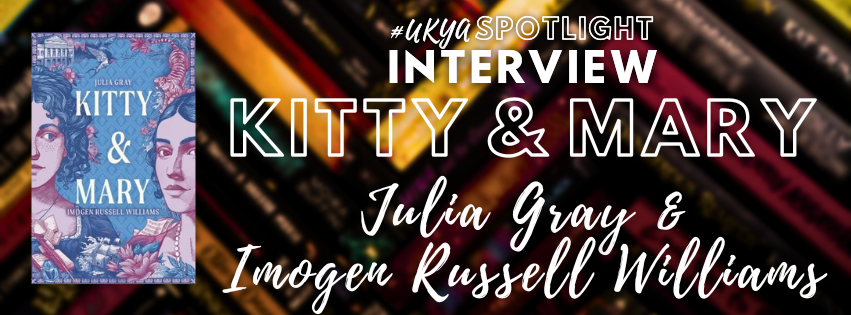
About the Book:
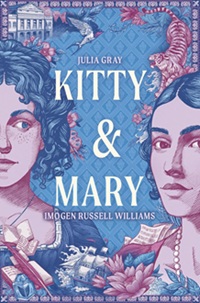
Elizabeth married Mr Darcy; Jane married Mr Bingley; Lydia married Mr Wickham. But what happened to the forgotten Bennet sisters?
Six months after Pride and Prejudice, Mary is stuck at home with her parents. So, when an opportunity arises that will take her to far away India, Mary jumps at the chance for independence and adventure.
Meanwhile, Kitty has been flitting between the estates of her sisters, searching for a suitable husband at every ball and dinner. When Mary sets off to India, Kitty’s disappointment at returning home is tempered by the revelation that a new tenant has come to Netherfield Park – handsome poet Mr Whittaker. He seems like the perfect husband for Kitty, but will he end up being everything she hoped?
Find on Goodreads. Find on Bookshop.org UK (affiliate link).
About the Author:
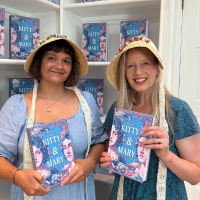
Julia Gray is an author and occasional singer-songwriter based in Oxfordshire. Her young adult novel The Otherlife (2016) was longlisted for the Branford Boase Award. Little Liar (2018) was shortlisted for Best YA Novel at Crimefest. I, Ada (2020) was shortlisted for the Young Quills Award for Historical Fiction. All three novels were published by Andersen Press and nominated for the Carnegie Medal. Julia presented a podcast series to accompany I, Ada, in which she interviewed women in the fields of maths and science. Julia has released six albums and regularly writes and performs music inspired by books; she is also the lead writer for the publisher Wonderbly.
Imogen Russell Williams is a children’s literature critic and author of children’s non-fiction including Great Britons and Great Elizabethans (Nosy Crow), The Big Book of the UK and The Big Book of Slimy Things (Ladybird) and a forthcoming book about magical creatures in folklore. She also writes poetry for both children and adults. Her first collection, The Women Left Behind, was published in 2019 by Dempsey and Windle; her second, Strange Sons, Dangerous Daughters, a revisiting of the Mabinogi, is published by Broken Sleep in 2026. Kitty and Mary is her first novel for adults and young adults.
Julia’s Instagram | Imogen’s Instagram
Interview:
Pitch your book in 10 words!
The forgotten Bennet sisters get to tell their own stories!
What drew you to give the characters of Kitty and Mary their own happily ever afters?
We both love marginalised or unjustly treated female characters (Imogen has a poetry collection called THE WOMEN LEFT BEHIND* which features characters like Rosaline from ROMEO AND JULIET, and Julia has written I, ADA, a fictionalised biography of Ada Lovelace). From the outset we were keen to have two voices talking to each other, so it made perfect sense to us to revisit the two unmarried sisters – the ones whose stories weren’t neatly rounded off at the end of PRIDE AND PREJUDICE.
Mary has already had her “story” told with a major adaptation on the BBC earlier this year. Were you aware of The Other Bennet Sister’s (then upcoming) adaptation when you set out to write this novel, and how did that influence your retelling?
IRW: I actually wasn’t! I was aware of the book, but quite remotely – I didn’t read it ahead of time, as I didn’t want my version of Mary to be unconsciously influenced by another writer’s portrayal. I knew PRIDE AND PREJUDICE had been revisited by a lot of brilliant authors and scriptwriters, and that interest in Jane Austen was particularly high around the time of the 250th anniversary of her birth, but I think we both just had a sense of P&P as being a perennially fertile source of inspiration – and we were both so keen to tell the unmarried sisters’ stories through the lens of their relationship.
JG: I didn’t watch The Other Bennet Sister until long after we’d completed KITTY AND MARY – like Imogen, I felt that we needed to stay true to our own vision while we were working on the text. I did really enjoy it and love the fact that PRIDE AND PREJUDICE (and the rest of Austen’s oeuvre) is able to generate so many reworkings and retellings, each different in their own way.
Both sisters end up not just on a romantic journey but one of huge personal development and self-discovery. Kitty in particular becomes a much more rounded individual who puts the effort into trying to redress the neglect of her “accomplishments”, even if for all the wrong reasons initially. What inspired her particular development?
JG: I had such strong memories of similar self-improvement odysseys undertaken as a young adult – I believed that if I just wrote down everything I wanted to achieve, I could magically make it all happen… I was also inspired by Caroline Bingley’s speech about a woman’s accomplishments in PRIDE AND PREJUDICE: although Kitty wasn’t in the room when she said it, I imagined how she might have reacted if she had heard it. I loved the idea that things would – of course – go wrong in amusing ways before (eventually) going right.
Austen’s letters settle the girls very differently to Kitty and Mary (a Vicar’s wife and Clerk’s wife respectively). In your reimagining, there is a beautiful sapphic love story that develops for Mary. Why did you want to centre a queer story in the world of PRIDE AND PREJUDICE?
IRW: I wanted to explore a different kind of happily ever after – for a very different kind of heroine – than marriage to a wealthy man. I liked the idea that Mary, as a rigid, rule-bound thinker, might not be aware of her own attraction to someone other than a socially-sanctioned potential husband, but that she might come to discover this deeper truth about herself – especially in the tight-framed, dangerous world of life aboard a ship.
Mary sails to India as a chaperone – and in hopes of a husband. Why did you want to send Mary overseas in the novel?
IRW: Mary is a social failure at home, the least attractive of her sisters and the least socially adept. I wanted to transplant her into a situation where she had better odds of being a desirable success, and also of ‘winning’ a husband, partly so she might realise that she didn’t actually want one! I also wanted to explore the India of the time a little bit from her outsider’s perspective – as I’m half-Indian, it was a voyage of discovery for me too. And I loved the fact that Jane Austen’s own Aunt Philadelphia had gone out to Madras to get married herself (something I didn’t learn until I was well into writing Mary’s story and Julia discovered it!)
Her trip goes the long way via the Cape of Good Hope as there was no Suez canal! What research did you have to do to build the voyage convincingly and what was your favourite tidbit you found whilst doing it?
IRW: I read a lot of wonderful books, including The Unfortunate Captain Peirce and the Wreck of the Halsewell, East Indiaman, 1786, by Philip Browne, which featured a harrowing account of the horrors of shipwreck. Patrick O’Brien’s HMS Surprise, the basis for the film Master and Commander, was riproaring fun, but the most exciting research I did was reading actual ship’s journals in the British Library, which were so special I felt like I shouldn’t be allowed to touch them! They’re all huge and filled with beautiful loopy cursive and they go through days and days of monotonous sailing and then suddenly there’s a storm or a mutiny or a sighting of enemy ships. I also visited SS Great Britain in Bristol – she’s a steam ship built later in the 1800s, but actually standing in the tiny cramped cabins was so helpful for getting the sense of life at close quarters – and the Caird Library and the Traders’ Gallery in the National Maritime Museum.
My favourite titbit was probably finding out that a ship with the captain’s wife aboard is known as a ‘hen frigate’ – that was right up there with discovering ‘haberdasher of pronouns’ as slang for a schoolteacher!
The book is told through letters and diary entries. What inspired this medium for the story?
IRW: Although PRIDE AND PREJUDICE isn’t an epistolary novel, it features some highly significant letters, and we felt that Jane Austen’s work overall resonates strongly with thoughtful and reflective forms like letters and journals. We also loved the idea that the reader gets to see the story on two levels – what each sister is willing to share when communicating with the other, and what they keep to spill out privately into their journals. This (hopefully!) provides a layer of humour, but also a deeper insight into the characters’ inner lives.
JG: It also reflected the way that we were working with each other – constant correspondence over email and WhatsApp – we couldn’t have written the book without being in a continual dialogue, so we loved that Kitty and Mary were doing the same thing.
Being a co-authored novel with two leads, an intuitive idea is for one author to write each character. Did you ever consider another way of writing it? How did you choose which character you’d write?
IRW: I don’t think we did consider another way of writing it! We both wrote some of the supporting characters – Julia wrote more of the original Bennet sisters – but from the outset I think we were clear that we would take one each of the main characters. Pleasingly we were each drawn to one of the sisters from the word go – we had a coy little conversation, and were delighted to find we both wanted the other!
JG: The narrative voice of each character needed to be unambiguous, so it definitely worked best for us to write one sister each, and then divide up the rest of the cast in a way that made sense. This approach also gave us more autonomy and greater freedom to go off and write and explore without feeling overly dependent on the other person. Then it was such a treat to be each other’s first reader and editor!
If you had to marry any of Austen’s romantic heroes (or heroines!), who would you choose and why?
IRW: Maybe not marry, but I desperately want to save Fanny Price, who gets such a raw deal in Mansfield Park and remains so strong despite being isolated and bullied all through her childhood!
JG: Because he was so gallant and nice – though not a proper “hero” – I liked Colonel Fitzwilliam.
Please recommend a UKYA book you think readers will love.
WONDERLAND* by Patience Agbabi – a joyous verse novel of self-discovery, dance and Northern Soul music, set in 1980s Wales
Thank you, Imogen and Julia!
*Affiliate link
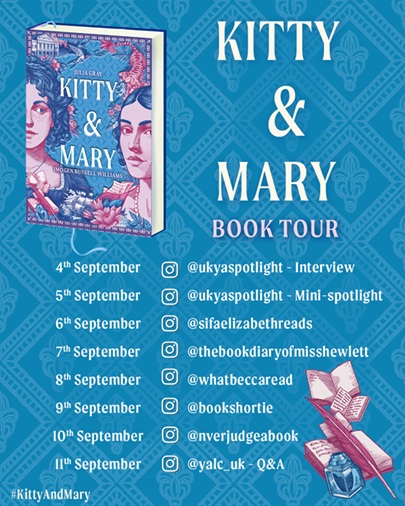
 #UKYASpotlight
Leave a comment