About the Book:
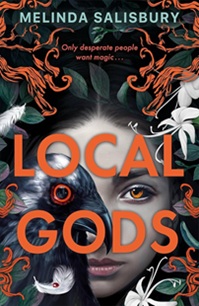
When a bone-white crow lands in Sylvie Singer’s backyard, she knows trouble is coming. And after an FBI raid reveals her father’s double life, Sylvie’s entire world comes crashing around her. With nowhere to go but the abandoned railway station in the cursed West Woods, Sylvie spends her time avoiding the carnivorous white deer that live there, counting down the days until she can graduate from high school and finally leave the town that’s openly out for her blood. Then Sylvie encounters a different sort of monster.
Illican is a horned god bound to the West Woods, even more wretched than she is. Sylvie is drawn to Illican, excited that he can introduce her to magic that could save her town—save her. But Illican is dying, and the last thing Pine Ridge Hollow wants is help from Sylvie Singer…
The town is a tinderbox, and Sylvie is the spark that will either save it or burn it all down.
Find on Goodreads. Find on Bookshop.org UK (affiliate link).
About the Author:
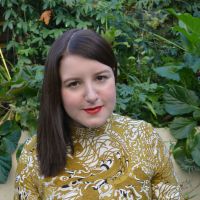
Melinda Salisbury is the four-time Carnegie nominated and bestselling author of multiple teen and young adult novels, including the Sin Eater’s Daughter series, Hold Back the Tide, and Her Dark Wings, a Guardian Children’s Book of the Year 2022 and a Reading Agency Book of the Year 2022 pick.
Her first novel, The Sin Eater’s Daughter, was the bestselling UK YA debut novel of 2015. Collectively her books have been nominated and shortlisted for numerous national and international awards, including the Waterstones Children’s Book Prize, the YA Book Prize, the Branford Boase, the Edgar Awards, the 2016 and 2019, 2021 and 2023 Carnegie medals, YALSA Best YA 2022, Eason’s YA Book of the Month, and more. Her books have been published in sixteen countries to date.
Melinda also works as a writing mentor and development editor and volunteers at a local independent cinema on the East Sussex Coast.
Interview:
Pitch your book in 10 words!
An outcast and a dying god find their fates entwined.
What was the spark that inspired the book?
As with pretty much all of my stories it came from images/fragments/feelings and me trying to fill in the gaps between them—I tell myself the story before I write it down. For LOCAL GODS I could so clearly sense a girl who didn’t believe in magic stumbling over a horned, very magical being in a woodland setting. And I knew they both lived in those woods and I knew they could help each other but that it would be dangerous for them to do so. And it spiralled out from there as more themes and images fed into it and I got a sense of the larger things at play in the world.
Sylvie regards magic as something she never needed before because “only unhappy people need magic” because previously her rich parents paid for her every wish. Do you agree or do you think we all need something that gives us a sense of comfort or control?
I do believe this, but let me be clear, I’m not talking about magic as part of a religious or spiritual practice when I say this! There are people who practice Wicca or animism or shamanism or who use what we’d term magic in their spiritual practice and they’re not the people I’m talking about when I say ‘only unhappy people want magic’ and I really want to underline that!
I’m thinking more about occasional or hobbyist users of the occult or magical practices – people (like me!) who draw Tarot cards to get a read on a situation or for answers to a question, people who do spells to bring back old lovers, or to bring money or luck, etc. Casual magic use. I see it in the same vein as people who only go to church or pray when there’s something bigger happening – that need for there to be a higher power, or someone in the driving seat and if we can just contact them we might be able to work it out. I think there are times in many people’s lives when we do need something that gives us a sense of comfort and control or that something or someone watching over us, and for some people that is traditional religion and for others its using tools like spellwork or Tarot or runes, etc.. I think this is possibly why magic and teenage girls are so inextricably linked – teenage girls have so little power and agency, who can blame them for trying to get it by whatever means they can?
Sylvie is drawn to Illican, the monstrous god of the woods – but the idea of finding monstrous nature gods hot is a tale as old as time. Why do you think we are drawn to the monstrous?
I think it’s a little to do with how people see themselves, whether that’s a conscious thing or otherwise. Because not everyone is drawn to the monstrous – to some it’s actively repulsive. But I think the people who do find it attractive or alluring are perhaps attracted to something they recognise in themselves – the qualities that make you an outsider or make you feel less worthy or worthwhile than others: somewhat monstrous, in other words. When you can see those things manifested as horns, or wings, or mismatched eyes—and especially when they’re coupled with magic, or power—it’s a powerful thing.
Sylvie is isolated after her father conned the town of its money – and then did a runner. Only three people are willing to speak with her more than the bare minimum; Chantry, Hunter, and Zelda. These three relationships are all so different. How did you go about making these relationships distinct? Did the nature of their relationships ever change across the course of writing and editing the book?
Chantry didn’t exist until the third draft! Zelda and Hunter existed from the beginning but Chantry was a very late addition. I think the relationships are distinct because the characters and their histories with Sylvie are so solid and also so distinct. Hunter and Sylvie used to be peers and equals, occupying the same social strata and they had a longstanding friendship and history and Hunter especially feels obligated by that.
Whereas Chantry is someone Sylvie used to look down on; she didn’t see Chantry as an equal, she saw her as the ‘weird girl’, a kind of joke, but that’s not something that would ever have bothered Chantry – she’s so comfortable with who she is that what Sylvie thought of her wouldn’t have affected her. But that’s also why she’s open to helping Sylvie—because she’s so secure in who she is, she has the inner room to be generous when Sylvie is down on her luck, despite their past. She’s the opposite of Hunter—he knows he’s supposed to ‘do the right thing’ but he won’t truly put himself on the line. Chantry isn’t bound by any kind of social expectations, she’s just a decent person and she will honour what she believes in and stand up for it. Hunter would repost some activism on Instagram and consider his duty done. Chantry would be in the streets, at the protests, putting herself out there and making her voice heard.
And Zelda has no skin in the Pine Ridge Hollow game at all – she’s a literal outsider and she doesn’t have the history with the Singers that everyone else in the town does so she can approach Sylvie on her own terms. Plus Zelda felt like an outcast when she was Sylvie’s age. It’s why she’s such a draw for Chantry and Esme and now Sylvie – it’s not dissimilar from what I said earlier about attraction to monsters, we’re often drawn to qualities in others that we recognise, consciously or not, in ourselves.
Names are so important to the town, with a special reverence for those tracing their ancestry back to the founders. How did you choose what to name your characters?
I don’t really choose names for characters in a conscious way – they have the names that are their names. I know on some level I must be making choices but it doesn’t feel like that! Sylvie was always Sylvie, Zelda was always Zelda, Hunter was always Hunter. Even Chantry, who came along so late, was Chantry from the start.
The book is incredibly atmospheric, putting the reader on edge from the start. What tips do you have for writers looking to create atmosphere in their own books?
I’d recommend thinking texturally about the environment. So much of what we experience is more than what we see, so incorporating sounds and scents and flavours into a world can really help make it more vivid. Also taking a moment to let things land. If you want to create atmosphere you have to get comfortable with sitting in it and letting it exist on its own terms.
LOCAL GODS is your second horror novel, after the stunning HOLD BACK THE TIDE*. While they have very different tones (small town versus eco horror, contemporary versus historic setting), they both have central nature themes, with monstrous creatures that arrive when we mess with it. How do you think our relationship with nature in a post-industrial era (at least in the UK) affects the role of the natural world in horror stories?
I think it’s rooted in the fact we are, for the most part, so removed from it. We live in brick and mortar cities and towns, our food is bought plastic wrapped from shelves, a lot of the time weather is something to be defeated or mitigated, we—at least in the UK—have no large natural predators we have to learn to live with. Nature is something to be kept at bay, maybe engaged with at the weekend if we’re ‘outdoorsy’. We are very unconnected from the natural world and we don’t have half the power or control there that we wish we did and that is scary, in a really fundamental way. It’s unknowable to us but it didn’t used to be. We used to be way more connected to it, and I think that feeds into our fears around it—that it used to be, if not friend then occasional ally. And it’s unpredictable too. I also think maybe there’s a little bit of residual guilt—we know what we’ve done to the natural world, how we’ve pillaged and mined and built over it. Maybe something deep down in us is just waiting for it to strike back because we know we deserve it.
Chantry uses the idea of cryptids to describe Illican. What’s your favourite cryptid and why?
It’s Mothman because he is the best. It’s as simple as that.
There are shades of THE CRUCIBLE in the way the families of Pine Ridge Hollow sustain the town and treat outsiders – and the play itself is one Slyvie is studying in school. What has given this play such an enduring appeal?
It still speaks to so much of modern life – how quick we are to turn on each other to save our own skins or to advance ourselves if we see a chance. How quickly we will invent mythologies and stories about other people to excuse the terrible things we’re willing to do to them. It’s a story as old as the human race itself, how we look at another person and instead of seeing a fellow human being we see—or make up—differences and we mutate those differences to dangers and as soon as we’ve done that we give ourselves permission to treat them as less than human. We ignore the unhoused on the streets when they speak to us. We blame a country’s woes on refugees instead of the people running the goddamned place. We say trans people are predators, we say people who support Palestine are terrorists. We other, and we other, and we other and that’s why THE CRUCIBLE endures. Because it’s as relevant today as it’s ever been.
Closed community small towns that hold grudges are a staple of horror. Why do you think this is such an enduring trope? What made you want to explore it?
I’m really interested in the dynamics of close-knit groups and how they sustain themselves because I think so much of the identities of the people inside them is tied up in being part of that group. Everyone within the group is defined by their role and the character they’re assigned and the narrative they’ve constructed and only way to keep that equilibrium is if everyone keeps doing their part, come what may. Think about how often groups change when someone gets married or has a baby or divorces or moves away or becomes ill or changes job—it’s not unusual for the people who have changed their ‘character’ to end up losing their groups because of it.
I think in horror generally it endures because we are a social species! So much of our survival depends on how we cooperate with the others in our little ecosystems and how much we rely on them for our continued survival – getting thrown out of the village into the dark means certain death! So the idea of something that should mean security being the threat is interesting to us, I think. I also wanted to play with a little by having the outsider not be a true outsider, but someone who was once very inside and had been recast by the group to suit their narrative. Being the outsider is a dangerous place to occupy.
Please recommend a UKYA book you think readers will love.
Savita Kalhan’s THE LOST NAME SOCIETY* – I am so excited for this book to come out. I’ve started read an early proof and it’s so much fun.
Thank you, Melinda!
*Affiliate link
 #UKYASpotlight
Leave a comment