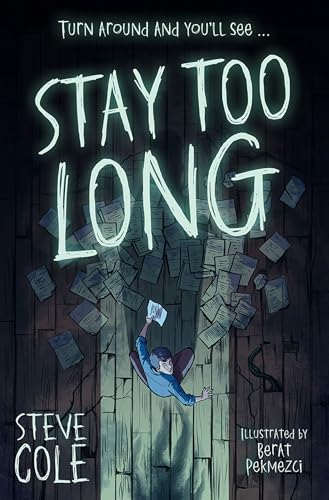
About STAY TOO LONG:
An ominous presence lurks in the shadows awaiting visitors who linger too long…
Everyone knows the abandoned old house at the edge of the woods is haunted, but one reckless boy steps inside for a dare. Creeping through the dust-covered rooms, he finds a strange message scrawled on the Stay Too Long. Then, he finds letters scattered on the floor written by previous visitors. Lingering, he begins to feel the chill of a strange presence in the gloom … is it too late to run?
Find on Goodreads. Find on Shelter Bookshop.org UK (affiliate link).
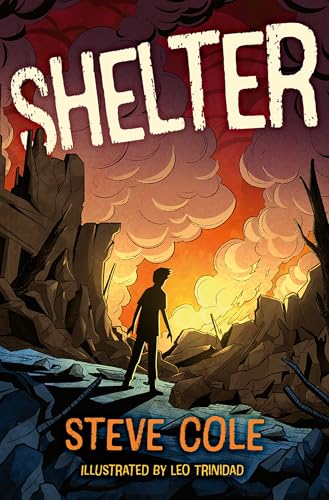
About SHELTER:
Danylo watches fearfully as war edges ever closer to his peaceful life on a Ukrainian farm. To prepare for the worst, he and his mother build a shelter for protection.
But when the missiles eventually drop, they’re unprepared for the devastating impact and must cling to all they have left in order to survive.
Find on Goodreads. Find on Bookshop.org UK (affiliate link).
About the Author:

STEVE COLE is an internationally bestselling author who has written over 150 books and sold over 3 million copies. He has written Doctor Who fiction, succeeded Charlie Higson as the Young Bond author and worked with Ben Fogle on his Mr Dog series. His books for Barrington Stoke include Drowning in My Bedroom, which won the 2024 Dudley Children’s Book Award: Short & Sweet Category.
Interview:
Pitch each book in 10 words! (Hard mode – pitch both with only 10 words between the two pitches!)
Stay Too Long: A new meaning for ghostwriter
Shelter: Any shelter can become a tomb.
Both STAY TOO LONG nor SHELTER have very short word counts akin to flash fiction. What are the strengths of flash fiction as a narrative medium?
When it’s done well, flash fiction reads as a concentrated narrative rather than an abbreviated one. It’s especially good for capturing a single charged experience.
Both books are illustrated, the better to aid comprehension for dyslexic, EAL, and reluctant readers. How closely did you work with Berat Pezmekci and Leo Trinidad to decide what illustrations you wanted in place of long descriptive passages?
The team at Barrington Stoke worked as go-betweens – layout out the book to maximise the impact of the words and illustrations. I was shown roughs and communicated my thoughts, then saw revised roughs for further comment before getting final art. I’m really happy with how the illustrations came out.
STAY TOO LONG is very much a traditional haunted house story. What served as your inspiration for this tale of terror?
I always enjoy ghost stories when you suddenly grasp what is happening just before the grisly ending. So I wanted to put a slightly different spin on the traditional haunted house story by having the words of the book be a part of the story.
How did you approach evoking a sense of terror in such a short word count?
With only, say, 1000 words to play with, each one has to used wisely. I wrote it longer and then cut, cut and cut again to try and reach maximum impact. I still get a tingle when I read the final two lines…
So much of horror is about the unknown. What tips do you have for writers when it comes to balancing enough information to follow a story while leaving gaps for the reader to fill in with their own nightmares?
I think you need to provide a sort of puzzle. When you’re in an old, broken down house and someone has scrawled ‘Stay Too Long’ on the wall – what does that mean? It’s an odd thing to encourage someone to do. That sense of being pursued by something unseen, of being trapped and unable to escape and not comprehending what is classic nightmare stuff. Most of us have experienced that visceral fear so I tried to tell the story sparingly so the events are actually triggers for the reader’s own terrors.
SHELTER deals with the harsh realities of the war for the people of Ukraine, which is in its fourth year now. How important to you was it to tell this story and get it right given many EAL readers are young Ukrainian refugees?
Well, my daughter-in-law is Ukrainian and is obviously very affected by the conflict and how terribly long it’s gone on for. There are so many people in dire danger all the time, so I wanted to write something about the war that would make people reflect on luck and chance and the parts they play in all our lives.
Were there any stories in particular from the Ukrainian War that inspired Danylo’s story?
I was actually remembering the stories my grandparents told about the Second World War, and how close they came to being killed – saved by a single decision which seemed like bad luck at the time. The fundamentals of war sadly don’t change much over time.
What do you hope readers take away from SHELTER?
The drip-feed of attacks on Ukraine can lead to desensitization and compassion fatigue. But the after-effects are as terrible each time. I hope readers will feel some compassion for people less fortunate than themselves, and to remember to value the simple things we sometimes overlook.
Please recommend a UKYA book you think readers will love.
The Haunting of Tyrese Walker* by JP Rose – a properly creepy mystery in a vividly realised setting.
Thank you, Steve!
*Affiliate link


Leave a Reply