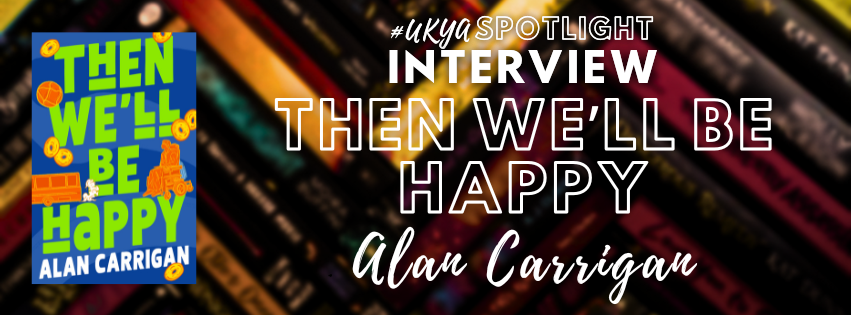
About the Book:
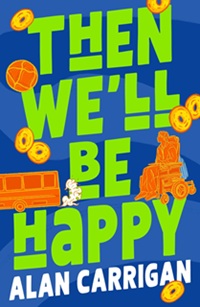
If you’re always thinking that the next thing will make
you happy … what happens to right now?
Seventeen-year-old Sam, who has cerebral palsy, wants some control over his life. When he is excluded from yet another school trip and has to spend the day with his bully, it’s the tipping point.
In his campaign for change, Sam gets more than he bargained for. But if you’re always thinking that the next thing will make you happy, what happens to right now?
Find on Goodreads. Find on Bookshop.org UK (affiliate link).
About the Author:
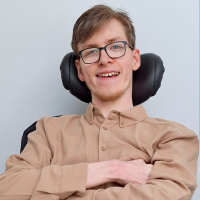
Alan Carrigan is an Irish novelist and screenwriter with quadriplegic cerebral palsy who has worked as a script editor for Ink and Light Films and D11 Stories, and was one of the writers selected for Screen Stories 2025 with Tilting the Lens and Screen Ireland.
His own work focuses on character-driven, witty, and nuanced stories, most of which feature the types of authentically disabled characters he needed but rarely saw growing up.
While his words can be found on the page, his eyes are often glued to a stage, as he is a big fan of musical theatre.
Interview:
Pitch your book in 10 words!
Coming-of-age story aiming to show a nuanced portrayal of disability.
THEN WE’LL BE HAPPY, is obviously a very personal book for you. How much of your own experience did you put into Sam’s story?
Consciously, Sam’s physicality is based on my own; however, I took a few creative liberties with the level of spasms sometimes, depending on what was needed for the moment. I was fortunate enough to never be bullied in school, so the actual plot is fiction, but I’m sure there are a few bits of me that snuck in subconsciously. I had such a great time in transition year going on the bus and tours, etc. That the idea came from flipping my experience on its head and imagining what it would be like if there was a student whose school wasn’t as accommodating as mine.
For your non-Irish readers, could you explain what a transition year is?
Sure! Transition Year or TY for short, is an optional gap year that you can pay for between two major exam years in the Irish school system. It’s meant to broaden your experiences and help you figure out what you might like to do with your life once you leave school. At least that’s the intended idea. Most people know it as a year when you go on lots of school tours and do lots of fun workshops with little to no homework. So, as you can imagine, it’s very enticing.
One of the most important subplots belongs to Patrick who begins the book as a bully. His journey and his friendship with Sam, Aimee, and the Power Chair Football team are really moving. Why did you want to include him in the narrative?
I wanted to explore the idea that even though Sam has been in a wheelchair his whole life, he has just as much, if not more, to learn than the newly disabled Patrick. I wanted to show that being comfortable with your disability means not only finding comfort in your physical ability, but the way you process things internally as well. Patrick, whether either of them realises it, is a crucial puzzle piece in helping Sam process all of that. I also just think it’s an interesting narrative juxtaposition.
Sam and Aimee make a pact to help raise money for getting an accessible bus, which pushes Patrick out of his comfort zone too and all of them learn about their internalised ableism. Why did you want to show Sam and Aimee confronting ableism? Especially as most people would be surprised that people with disabilities can be ableist?
I think you’ve answered this question in the phrasing of it. Most people, including disabled people, would be surprised that disabled people themselves can be ablest. I didn’t realise that when I was younger, but I think it was massively important for me to learn, and I think the sooner people can recognise it within themselves, the better. Now, personally, I probably still have a little bit of internalised ableism towards what I think is possible for my own life, but it’s not something you magically turn off. Just like you don’t magically reach a point where you’re constantly happy all the time; it comes in ebbs and flows, but once you’re conscious of it, that’s the main thing. Also, I’m just one person who is still learning, so maybe my answer will change over time.
Are there any activities you want to challenge yourself to have a go at like Sam and Aimee?
I did do both Powerchair Football and sailing when I was younger, at different points in my life. But I’m not a sporty guy. I’m much more of a theatre kid, so I would love to try something theatre-related, not on stage, but I would love to write something or work backstage in some capacity. The theatre industry is incredibly inaccessible for disabled people, which is why I didn’t do it right away, but I would say that’s one of my biggest life goals, and I know there are companies out there that might be able to help but it’s just about finding the right time.
THEN WE’LL BE HAPPY is unflinchingly honest about the realities and indignities of living with quadriplegia – poor Sam just can’t catch a break missing trips and concerts because of his medical needs. What do you hope people take away from Sam’s experiences?
It is not my place to say what people may take from the book. Still, it is honest because I didn’t want to shy away from the reality of what it’s like living with a disability in both my experience and the experience of the people who I interviewed while researching this book. My goal for this book wasn’t to make a super inspirational book or a medical learning book. My goal was to show that life is full of ups and downs for every character, including disabled characters. It’s just that up until now we have had very little three-dimensional representation; we’re starting to see more disabled writers creating stories now, so I hope the types of representation will only get more varied as the years go on.
Sam is incredibly capable, intelligent, brilliant at graphic design, and constantly fighting against infantilisation. Why do you think this condescending attitude is so prevalent?
It goes back to my last point. If you’re seeing something in the media, that can often be your only exposure so if characters on TV or in movies treat disabled people in a certain way, I think that can sometimes bleed into the real world. I also think in the case of the characters of Ben and Pamela in this book, it’s generational. Ben is learning from his parents, whether he knows it or not. Of course, he could make up his own mind, but I’m getting into spoiler territory here, so I’ll just leave it at that.
Please recommend a UKYA book you think readers will love.
Jenny Ireland’s The First Move* is, at first glance, an intriguing online chat room romance that blossoms into a story about disability and one’s ability to love. All topped off by Jenny’s signature Northern Irish wit.
Thank you, Alan!
*Affiliate link


Leave a Reply