About the Book:
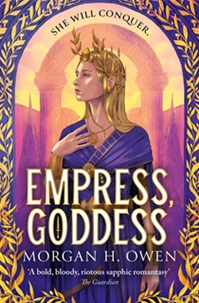
Rome has crowned a new Empress, but the Gods are far from finished with her.
Claudia’s rule is fragile from the moment it begins. Assassins stalk the palace, the Senate turns against her, and ancient deities manoeuvre for power. Forced into dangerous political alliances and a marriage she does not want, Claudia must hide both her doubts and her forbidden love for her fiercely loyal bodyguard, Gia.
As rival claimants rise and divine war looms, Claudia is pushed to choose between authenticity and authority, love and survival. Every decision tightens the trap, and the cost of power may be higher than she can bear.
Find this book on Goodreads and Bookshop.org UK (affiliate link)
About the Author:
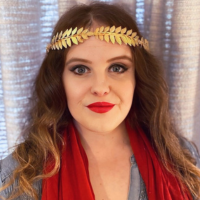
Former Waterstones bookseller Morgan Owen lives in her own little world, but which world in particular depends on the day. A lifelong fan of escaping reality, she was first published at the age of 12, reviewing the Tom Cruise fan club website (it was okay). She regrettably didn’t graduate from Birmingham University but she’s had lots of different jobs, including as a music journalist and a film PR executive. Morgan is amicably divorced from her American ex-wife and has two black cats called Salem and Binx. Her passions include pop culture, cosy gaming, retrofuturism, space and lucid dreams.
The Rome that never was:
The best thing about writing alternate history is that anything is possible, and the worst thing about writing alternate history is that everything is possible. It’s a delicate game of knowing when to stand firmly behind the historical line, when to boldly step over it, and when to carefully shimmy under it like a limbo pole.
I’m a big fan of books that explore the what-ifs and how-coulds of human history, stories that feel like parallel timelines branching off from our own reality – books like Noughts and Crosses, The Man in the High Castle, Never Let Me Go or The Underground Railroad. By my definition, alternate history can also include books like A Handmaid’s Tale or 1984, which mirror our society in such an uncomfortably close way it feels likely that these events unfolded somewhere in the infinite matrix of spacetime.
When I began writing Gladiator, Goddess (and its sequel, Empress, Goddess), I knew the story I wanted to tell required a serious revision of history. The question of how accurate it could or should be came up early in the process. As any time-traveller could tell us, small changes to historical events can have huge ramifications. Even subtle nudging of the facts has a butterfly effect in which one difference leads to another, and another. This can create an endless loop of anachronisms that prevents writers from actually writing — by trapping us in a loop of meticulous research. For example, the lineages of emperors in the relevant period didn’t align well with my plot, so after much hand-wringing and shouting at clouds, I decided to create an entirely fictional family tree instead.
This is a feminist book and admittedly, the modern concept of feminism simply didn’t exist in ancient Rome, yet the foundation was there. Roman women were defined by the patriarchy. They could own businesses if they had the means, but they were denied the right to vote, they couldn’t stand in the senate and they couldn’t join the military. Roman women are named less frequently in history, which was recorded by mostly male historians, and while there are exceptions of women who rose to prominence, like Lucretia, Fulvia, Julia Felix and my fictitious Claudia, these circumstances weren’t replicable for lower-status women, who largely served the empire as mothers, nurses, midwives, slaves and prostitutes. The age of consent was 12 for girls – two years younger than boys – and marriages were typically arranged by the girl’s father.
Powerful women were always present, however, in the images of the goddesses, of which there were many, revered by Roman men and women alike. These glorious figures were perhaps both aspirational and enviable to Roman women: a reminder of a woman’s potential strength and might, but also a reminder of an absent freedom. The pantheon presented, at least superficially, a kind of equality not mirrored in Roman society. One of my favourite scenes in Empress, Goddess is when Claudia points out this contradiction: the goddesses are depicted as warriors, but mortal women can’t fight. This underpins one of the core concepts of the book: that Roman society was inherently chauvinistic due to its fixation on conquest and the power of the phallus, and that no woman, not even one of Claudia’s birthright and privilege, would be treated equal to even the lowliest of men.
There were many complexities to Roman cultural life that highlighted this moral hypocrisy – for example, male-male relationships were viewed as common and socially acceptable, inspiring a lexicon of terms to describe different relationship dynamics, while female-female relationships are barely recorded at all. Because of this, I felt free to reimagine a lost history: the stories of queer women who existed without definitions or social recognition. The Gladiator, Goddess duology reimagines Roman society if feminist theory and lesbian identity had emerged much, much, much earlier. The lack of solid historical accuracy is actually the foundation of the story in this instance.
Alternate history takes the past and flips it, inverts it, stretches it and pinches it. The elements, names and places are often recognisable, but shaped into a new form. As a writer first and an amateur historian second, I always prioritise fiction over fact, but I know that a careful balancing of the past is also key. Historical fiction works best when it is written between the lines of what already exists, if we can find enough room there. Yet I can also appreciate an alternate history that’s more of a margin-scribbler: it takes liberties and exists in its own weird metaphysical space off-page. It’s more of a scrapbook approach, where the author cuts out various bits of history and pastes them onto a blank canvas. A historical mash-up, if you will.
Writing about a real time period is very fertile, creatively. There’s a wealth of inspiration already there to be stitched and spun, but only when we’re not encumbered by what is and isn’t feasible. For me, the point of historical fiction is that we use history as a lens through which to view our own society, which sometimes involves applying modern concepts to ancient worlds. Retelling these ancient stories within a culturally-accurate framework doesn’t inspire new perspectives like it does when we flip the story upside-down – and we can only truly do that by applying our experience of modernity to the past.
Is it probable, within our own history, that a young woman like Claudia would ever be named empress of the Roman Empire? Probably not. But is it possible in this alternate version of Rome – this Rome That Never Was, where small differences accumulated to create a new and entirely different timeline? That is the question I attempted to answer in writing Empress, Goddess.
Thank you, Morgan!
*Affiliate link
 #UKYASpotlight
Leave a comment