About the Book:
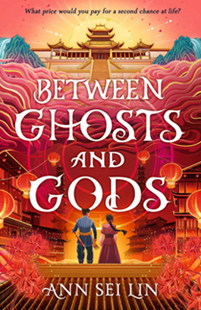
Having sold her soul to a demon lord, Kasu works the exchange desk at Camellia House, a high-stakes gambling den in the under-realm. Here, in Ghost City, Kasu keeps her head down, following the strict moral code of the Heavenly Principles in hopes of one day achieving reincarnation. Night after night, she dispenses gambling tiles to customers who surrender their treasures—jewelry, limbs, dreams—which Kasu stores in a ghoulish cabinet for her mistress. Into this regime drops Arun, a brash mortal prince in search of his mother. Desperate to honor her code and spare the foolish young man—as innocent as he is arrogant—a fate worse than death, Kasu enlists her companion “curse” Ruo, a wise-cracking cat with an appetite for eyeballs, and mounts a rescue. As danger and deceit engulf her, Kasu must reexamine her beliefs about the gods she worships . . . and the mortal she was.
Find on Goodreads. Find on Bookshop.org UK (affiliate link).
About the Author:
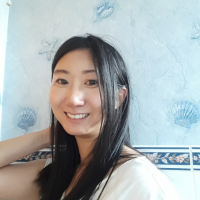
Ann Sei Lin is a writer and librarian with a love for all things fantasy. Though London is now her home, she spent several years living and working in Chiba, Japan. When not writing, she is often studying, gaming, or trying to make that origami rabbit for the one hundredth time.
Interview:
Pitch your book in 10 words!
Ghost-girl tries desperately to keep clueless human alive in hell
BETWEEN GHOSTS AND GODS is based on the folklore and mythology you grew up with. Why did you choose to create your own pantheon based on these rather than directly using this mythology?
I wanted to create my own pantheon in part because it gives me more freedom to create the story I wanted to tell, but also because I didn’t want to seem like I was making a statement on a specific religion. BETWEEN GHOSTS AND GODS is a fantasy and the gods are meant to represent hypocritical, self-serving power structures that can be found anywhere, not just religion. I think using real, specific gods would have undermined that.
The ghost town has four distinct quarters, each ruled by their own demon lord. Which quarter would you rather spend your time in?
Definitely the theatre district in the western quarter. The Pale Lady, who rules the district, is a terrifying eldritch monster with a penchant for emerging from her servants’ mouths, but I reckon that as long as I avoid her I’ll be fine. At least in the theatre district you can catch a show, listen to musicians, and drink some tea. If the shows weren’t awful, the music depressing, and the tea probably poisonous, it would be my ideal day out!
This book is a bit older – and darker – than your debut trilogy. What was the most challenging thing about this new tale? The most freeing?
My biggest challenge was getting the right balance between darkness and humour. Kasu lives in a cut-throat world, but I didn’t want it to be relentlessly dark or hyper-violent. The under-realm is a dangerous place, but it’s also home to hundreds of ghosts and demons who live, work, and even find some entertainment down in hell.
The most freeing part was being able to explore more mature themes and to raise questions in the narrative without needing to give neat or easy answers.
Kasu is obsessed with following the Heavenly Principles in order that once she has served her time to Lady Camellia she might achieve reincarnation. What inspired the principles?
I think all religions have rules or guidelines that they ask their faithful to follow. Many of them are good rules (don’t kill people, don’t steal from others, and such) but we’ve all seen or heard of religious leaders having affairs when their faith tells them not to commit adultery, or encouraging violence when they shouldn’t. We’re no stranger to those in charge acting hypocritically in light of the rules they espouse. The heavenly principles was inspired by that. The gods set a bunch of rules for others to follow, but they themselves break those rules all the time.
Throughout the book Kasu and Arun butt heads over what makes a person worthy of reincarnation when people who commit horrific acts but are somehow noble get to reincarnate whilst those who commit one mistake or die horribly must suffer the under realm as a ghost. Why did you want to explore this idea?
I don’t remember the first time I heard the phrase ‘pull yourself up by your own bootstraps’, but I remember encountering it most often from the mouths of news pundits, usually when talking about the working class, or social programmes, or the economy.
When I wrote about Kasu and Arun’s takes on reincarnation, I was thinking about the phrase about bootstraps. Kasu was a child when she was forced to sell her soul, but she has internalized the gods’ view that her misfortune is entirely her fault. Those who die in war can become hungry ghosts, but is it their fault they were sent to die? Kasu won’t entertain nuance. She can only believe that she is one hundred percent responsible for everything that happens to her all the time. In a way, it is a comforting lie. If personal responsibility is all there is, there are no systems holding her down. No one stacking the board against her. She and everyone else in the under-realm can boot-strap their way to reincarnation.
I think that’s what makes Arun such an interesting foil against Kasu. Despite his position of privilege, he can see that the gods have made arbitrary rules about worthiness that they don’t adhere to themselves. His suspicion balances out Kasu’s blind belief.
Ruo is a Curse made manifest as a cat (and we love him). How did his character come into being and was he always part of the story?
This story would never have come to fruition without Ruo! Honestly, part of the inspiration behind their character came from the multitude of cat videos I have watched (particularly of cats knocking things off tables and generally being little menaces!) Another part of the inspiration was Power from Chainsaw Man. Ruo is a rather toned down version, of course. Despite constantly wanting to eat people, they’re is a lot less violent than Power, but Ruo is still the type to lie, conveniently make stuff up when it suits them, show reckless regard for other people’s property, and will always go on about how mighty and impressive they are. (And that’s why they’re the best!)
Please recommend a UKYA book you think readers will love.
GLADIATOR, GODDESS* by Morgan Owen
Thank you!
*Affiliate link


Leave a comment