About the Book:
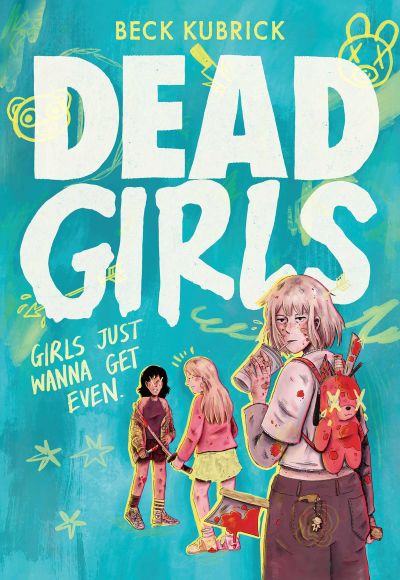
A love letter to slasher films and angsty teenage friendship, Dead Girls is a graphic novel perfect for fans of Holly Jackson, Emily Carroll and Yellowjackets.
Clossdale has a history of dead girls. When a fifth missing teenager turns up dead, all eyes on are one suspect – 17-year-old Ash, the orphaned daughter of serial killer ‘Evil Evelyn’.
Ash is sick of her peers being murdered, and she’s sick of the police not taking the investigations seriously. After finding a note telling her she’s next, Ash, along with her foster sister Cassie and best friend Jamie, decides to take matters into their own hands.
But when their plan goes awry, the girls find themselves at the centre of a deeper and darker web than they could ever have imagined. Can they put a stop to the murders, or will they each become just another of Clossdale’s dead girls?
Find on Goodreads. Find on Bookshop.org UK (affiliate link).
About the Author:
Beck Kubrick is an award-winning writer and cartoonist living in Manchester, UK. They like stories about terrible girls and thinking about the apocalypse. They have worked with Cartoon Network, Mad Cave Studios, Oni Press, and more. Dead Girls is their debut graphic novel as author-illustrator.
Girls in horror: who do we root for and who deserves to die…violently?
Horror has a complex history with women and girls, in some ways it was ground-breaking and in others it was not. In a traditional slasher, the final, lone survivor is a teenage or young adult girl or woman, which is ground-breaking…right? Not always, sadly.
Carol J Clover, who coined the term ‘final girl’, identified the characteristics a ‘final girl’ must often subscribe to; she is pretty, white, wealthy and essentially falls into a societal view of what a girl ‘should’ be. She is the platonic ideal of a girl, written by and for men. She is virginal and innocent and she only fights back once she has been sufficiently tortured and has no other choice…because a girl would never choose to be violent, right? She has to be forced into it.
All stories are inherently political, especially horror. Halloween (1979) is a genre defining slasher film that is about the teenage Laurie Strode and her friends, who are under attack by a man in a big mask with a big knife. But it’s also about the rapidly changing political landscape, white flight and the idea that even your wealthy white suburb isn’t safe anymore…chilling. But that’s a very difficult, vague concept to hold onto, so making it a story about a guy in a William Shatner Mask (really!) is easier. The ideas of wider society seep into the stories we tell and then those ideas are reflected back at us.
Clover believes it has to be a final girl as the audience couldn’t believe or root for a man who won’t fight back immediately. Therefore, a woman must act as a stand in for society and status quo- and she must be the best kind of woman; a girl. And she must be the platonic ideal of a girl. The bad guy is whatever scary thing is in the public consciousness at the moment. The girl is pushed to the edge, she fights back only once everyone else is dead…but he still gets away somehow, even when it seems she’s won, because society is still fighting this fight and come on, girls can’t really win. A girl is innocent and perfect, because the people who historically wrote these stories were people who benefited from society and the status quo and viewed girls as such.
The final girl is pretty but only in a girl-next-door-way, she can’t know it or God forbid, flaunt it. She is tomboyish, often with an androgynous name, maybe she plays sports but don’t worry, she still has long hair and is not too muscular. She doesn’t worry about ‘girly things’, she’s willing to get dirty and fight, she’s smart and uses her wits to avoid murder. But this is not a statement on girls and women at large, she survives precisely because she is not like other girls. The other girls, narratively, deserve to die, due to flaunting their sexuality, engaging in taking drugs or drinking alcohol; essentially breaking the status quo of society and what is a ‘good girl’. When these girls die, their deaths are often sexualised, the audience is invited to celebrate, much like Paris Hilton’s character’s death in House of Wax (2005). Anyone who is ‘other’ ‘deserves’ to die as seen in the Sorting Algorithm of Mortality by TV tropes.
Even in subversive meta-slasher Scream (1996), which overtly played with and updated slasher tropes; Sidney talks down on other girls, “Some stupid killer stalking some big-breasted girl who can’t act who is always running up the stairs when she should be running out the front door. It’s insulting.”. She is expressing that this is insulting due to the filmmakers choices, yes, however she is still inherently sexualising a girl’s body as if the very fact she is ‘big-breasted’ is a negative thing and is ascribing immorality to this trait.
Returning to the idea of a girl being tortured before she fights back, Clover says this is to ‘force’ audiences to empathise with her, as audiences are programmed for women and girls to play certain roles. Historically, stories were mostly written by and for men, so women were written within a narrow scope and lack of dimensionality, they existed purely for whatever function or service they provided the male, hero character. She is a love interest, doting mother, innocent girl etc.- all things society believes women ‘should’ be.
On the flip side, within Barbara Creed’s theory of the ‘monstrous feminine’; femininity, traditionally feminine traits and natural parts of womanhood are demonised. A woman who dares to…age and…not be conventionally attractive by society’s standards is cast as a hag or a crone, close ups of her body are intended to disgust us, like in The Shining (1980). Whilst a woman who takes charge of her sexuality and agency rather than being coy or submissive is a witch. A teen girl going through puberty is not a child experiencing rapid hormone changes and an unavoidable part of growing up, she becomes a monster as in Carrie (1976) or The Exorcist (1973). We never forgive teenage girls for growing up and losing their innocence.
In films, an action hero is allowed to take out ten henchmen (even if he claims he doesn’t kill, looking at you Batman) and he is still a hero. Men are allowed violence, range and anger on screen. In many films, such as Taken (2008) or Old Boy (2003), a woman is hurt and we follow our hero, a man who loved her in some way. It is not the treatment of a human being that is the problem, that ignites this revenge, we follow a man who loves her or perhaps, owns her (figuratively) and the treatment of his property. A girl is a victim, a man seeks revenge.
So, girls aren’t supposed to get angry or violent. It is not ground-breaking for girls to fight back when it’s kill or be killed, they’ve been doing that forever in slasher films, even if sometimes they are ultimately saved by a man who is representative of society or part of it, such as a police officer. So I wanted to push it further; what about final girls? Can we love them? What about girls who aren’t willing to wait to be tortured and for everyone else to be killed before they retaliate?
What if they’re pro-active? What about girls who are angry and have been in fights before? What if they’re good at it? What if they like it?
My book is as much a love letter to horror stories and slasher films as much as it is a death threat. Ash is white, she isn’t super feminine, she has an androgynous name. Her friends, who are arguably also final girls, hit on certain other tropes and don’t hit others. Total negation of a thing is still giving it power. Ultimately, I wasn’t trying to trojan horse feminist theory into my story or even actively thinking about it, I just wanted a story where the girls get to be messy and angry and feel like they were written by and for people who don’t often get to be heroes, for whatever reason. I think girls and women are people and should be written as such.
There’s been a rise in female filmmakers, storytelling. We’re getting female rage stories, good for her stories and coming or rage stories but I want more. I don’t want stories where women just do what men would do, I don’t want female James Bond, I want stories by and for women and girls and other groups who haven’t traditionally got to tell their stories to get to tell their stories. I want more girls! More freaks! More weirdos! Now!
Thank you, Beck!


Leave a comment